marginaliaA PODCAST

BOOKS. RESEARCH. IDEAS IN CONVERSATION.

Understand the arguments.
Form your own view.

Marginalia brings books and research into conversations about how we think, speak, remember, and live together.

Listen to learn, question what you hear, and take the debate further.

Explore the episodes

THE LATEST CONVERSATIONJew-Hatred: The Latest Edition (Simon Schama)

Marginalia podcast artwork: handwritten notes on parchment surrounding the title, with red annotations
For the questions that stay with you.

READ CLOSELY. THINK TOGETHER.

Explore philosophy, artificial intelligence, linguistics, psychology, history, art, and science through the ideas and questions in the source texts. Listen to learn, question what you hear, and take the debate further.

About Marginalia

Find your next deep dive in seven subject series:

  • Philosophy & Critical Theory — Ricoeur, Adorno, truth, interpretation, and ethics.
  • AI & Computer Science — Learning, world models, and the ideas behind intelligent machines.
  • Language & Linguistics — How language works, develops, and evolves.
  • Mind & Psychology — Consciousness, cognition, development, and human behavior.
  • History & Judaism — Jewish history, memory, and how we understand the past.
  • Art & Music — Aesthetics, creativity, and ways of listening.
  • Mathematics & Science — Mathematical ideas, scientific reasoning, and how we establish knowledge.

AI Papers connects recent research with historically significant work.

Human-curated, with conversations produced using NotebookLM.

More from the creator

THE MARGINALIA LIBRARY

Follow a question.

90 deep dives
Seven subjects · Books and papers

90 episodes

Source cover or first page for Jew-Hatred: The Latest Edition (Simon Schama)

History & Judaism

Jew-Hatred: The Latest Edition (Simon Schama)

Simon Schama asks why antisemitism persists and adapts across different political and religious settings.

About this episode

Jew-Hatred: The Latest Edition, published in Jewish Quarterly 265, connects recurring historical myths with contemporary hostility toward Jews.

His essay examines religious prejudice, conspiracy thinking, and the repeated use of Jews as an explanation for wider social anxieties.

Schama also considers the October 7 attacks, the war in Gaza, and arguments about Zionism within the current resurgence of antisemitism.

The discussion centers on historical evidence, collective blame, and the consequences of these arguments for Jewish life and public debate.

Original sourceThe Final Solution to the Jewish Question: A Love Story for the Living (Dara Horn)Confronting Antisemitism: Fighting Antisemitism Today (Theodor Adorno)The Concept of God After Auschwitz: A Jewish Voice (Hans Jonas)
Listen
Source cover or first page for Machine Voices: A Sonic Study of Artificial Intelligence (Edward B. Kang)

Art & Music

· Book deep dive

Machine Voices: A Sonic Study of Artificial Intelligence (Edward B. Kang)

What assumptions about speaking and listening are built into a machine that claims to understand a voice?

About this episode

Edward B. Kang investigates how artificial intelligence turns voices into measurable, comparable, and reproducible signals.

The book moves from the histories and framing of voice to machine listening, engineered emotion, and synthetic speech.

Kang connects these technical practices with the economic, social, and cultural forces that shape what a system recognizes.

His concept of the machine voice opens a debate about whose voices count, which standards guide listening, and how technology changes our understanding of human expression.

Original sourceHow the Body Shapes the Way We Think: A New View of Intelligence (Pfeifer & Bongard)Syntactic Theory: A Formal Introduction (Ivan Sag, Thomas Wasow & Emily Bender)World Models and V-JEPA: Learning from Video (Yann LeCun & Adrien Bardes et al.)
Listen
Source cover or first page for On Minds: Reflections of a Cognitive Architect (Paul S. Rosenbloom)

AI & Computer Science

· Book deep dive

On Minds: Reflections of a Cognitive Architect (Paul S. Rosenbloom)

What kind of architecture could support a mind across different tasks and situations?

About this episode

Paul S. Rosenbloom examines architectures, symbols, intelligence, and theories through decades of research in artificial intelligence and cognitive science.

He maps the choices and trade-offs behind symbolic, neural, and hybrid approaches to intelligent systems.

His account connects work on XAPS, Soar, and Sigma with the search for a Common Model of Cognition.

The book combines conceptual analysis with a research memoir, asking how the fixed organization of a system can make flexible thought possible.

Original sourceHow the Body Shapes the Way We Think: A New View of Intelligence (Pfeifer & Bongard)World Models and V-JEPA: Learning from Video (Yann LeCun & Adrien Bardes et al.)The Origin of Concepts (Susan Carey)
Listen
Source cover or first page for CLIP: Learning Transferable Visual Models From Natural Language Supervision (Radford et al.)

AI & Computer Science

· Historical classic

CLIP: Learning Transferable Visual Models From Natural Language Supervision (Radford et al.)

CLIP asks whether natural-language descriptions can teach a visual model more flexibly than a fixed set of class labels.

About this episode

Radford and colleagues train image and text encoders on 400 million image-text pairs using a contrastive objective.

Text prompts then describe new categories, allowing the model to attempt classification without task-specific labeled training examples.

The paper evaluates transfer across more than 30 vision datasets and examines robustness, prompting, and the limits of the approach.

This foundational study provides a historical counterpart to the JEPA paper: paired contrastive training offers one route to shared visual and linguistic representations.

Original sourceYann LeCun & Randall Balestriero: The Platonic Representation Hypothesis with JEPAsWorld Models and V-JEPA: Learning from Video (Yann LeCun & Adrien Bardes et al.)Backpropagation: Learning Representations by Back-Propagating Errors (Rumelhart, Hinton & Williams)
Listen
Source cover or first page for Yann LeCun & Randall Balestriero: The Platonic Representation Hypothesis with JEPAs

AI & Computer Science

· Recent research

Yann LeCun & Randall Balestriero: The Platonic Representation Hypothesis with JEPAs

Can models trained separately on images and language arrive at the same representation of the world?

About this episode

Randall Balestriero and Yann LeCun derive alignment up to a rotation for an idealized JEPA setting with shared positive pairs and additional assumptions.

They distinguish good views of the same scene from views that preserve the peculiarities of a single observation.

Experiments report stronger cross-modal alignment and substantially greater sample efficiency than next-token prediction in the tested settings.

The results concern cross-modal alignment under specific assumptions and benchmarks, making their scope central to interpreting the broader claims.

Original sourceCLIP: Learning Transferable Visual Models From Natural Language Supervision (Radford et al.)World Models and V-JEPA: Learning from Video (Yann LeCun & Adrien Bardes et al.)Backpropagation: Learning Representations by Back-Propagating Errors (Rumelhart, Hinton & Williams)
Listen
Source cover or first page for Deep Learning for Finance: Creating Machine & Deep Learning Models for Trading in Python (Sofien Kaabar)

AI & Computer Science

· Book deep dive

Deep Learning for Finance: Creating Machine & Deep Learning Models for Trading in Python (Sofien Kaabar)

Sofien Kaabar explains how to build Python models for financial time series, combining machine learning with technical and quantitative analysis.

About this episode

The book develops the probability, statistics, linear algebra, and data-handling foundations needed for these models.

It progresses from regression and tree-based methods to neural networks, recurrent architectures, and deep reinforcement learning.

Backtesting, time-series cross-validation, regularization, and retraining help examine model performance and the risks of overfitting.

Market drivers, risk management, and behavioral biases place the modeling techniques within the wider practice of financial trading.

Original sourceAn Advanced Course in Probability and Stochastic Processes (Kroese & Botev)A First Course in Causal Inference (Peng Ding)
Listen
Source cover or first page for How the Body Shapes the Way We Think: A New View of Intelligence (Pfeifer & Bongard)

AI & Computer Science

· Book deep dive

How the Body Shapes the Way We Think: A New View of Intelligence (Pfeifer & Bongard)

Rolf Pfeifer and Josh Bongard argue that intelligence depends on interactions among the body, the brain and the environment.

About this episode

How the Body Shapes the Way We Think: A New View of Intelligence uses embodied systems to explore that claim.

Robot designs show how physical form and coordination can contribute to behavior.

The discussion connects these ideas with development and the emergence of cognition.

The book offers a way to question accounts of intelligence that focus primarily on computation inside the brain.

Original sourceNeuromorphic Intelligence: Learning, Architectures and Large-Scale Systems (Shuangming Yang & Badong Chen)Bayesian Models of Cognition: Reverse Engineering the Mind (Thomas Griffiths, Nick Chater & Joshua Tenenbaum)
Listen
Source cover or first page for Any Time, Any Space: Coherent Video Generation (Weijie Wang et al.)

AI & Computer Science

· Recent research

Any Time, Any Space: Coherent Video Generation (Weijie Wang et al.)

Any Time, Any Space tackles the problem of keeping generated video shots consistent across changes of place, viewpoint, and time.

About this episode

The framework turns a screenplay into shot requests with explicit scene, camera, and event-time references.

Scene memory stores registered static geometry, while event memory retains dynamic observations indexed by scene, event, and time.

Before generating a shot, the system retrieves relevant evidence; afterward, review and state checks decide whether new observations enter memory.

The authors report improvements in cross-shot consistency, spatial revisiting, and event replay across four video generators.

Original sourceWorld Models and V-JEPA: Learning from Video (Yann LeCun & Adrien Bardes et al.)VisionHOPE: Visual Backbones as Self-Modifying Learning Systems (Siran Peng et al.)
Listen
Source cover or first page for An Advanced Course in Probability and Stochastic Processes (Kroese & Botev)

Mathematics & Science

An Advanced Course in Probability and Stochastic Processes (Kroese & Botev)

Kroese and Botev build a rigorous account of probability from measurable spaces, integration, and random variables.

About this episode

They compare different forms of convergence and develop the law of large numbers and central limit theorem.

Conditional expectation connects information and independence to Markov chains and other stochastic processes.

Martingales, stopping times, and Brownian motion reveal how random systems evolve over time.

The book brings these ideas together through stochastic integration, Itô calculus, and stochastic differential equations.

Original sourceA First Course in Causal Inference (Peng Ding)Graph Theory (Reinhard Diestel)
Listen
Source cover or first page for Human-in-the-Loop Machine Learning: Active Learning and Annotation for Human-Centered AI (Robert Monarch)

AI & Computer Science

· Book deep dive

Human-in-the-Loop Machine Learning: Active Learning and Annotation for Human-Centered AI (Robert Monarch)

Robert Monarch explains how human judgment and machine learning can work together to build better models.

About this episode

Active learning uses uncertainty and diversity sampling to select examples that most need human feedback.

The book examines how to recruit annotators, write instructions, and measure agreement and annotation quality.

It connects reliable training and evaluation data with transfer learning and other ways to improve labeling workflows.

Annotation interfaces and human-computer interaction bring these methods together in practical machine learning products.

Original sourceBackpropagation: Learning Representations by Back-Propagating Errors (Rumelhart, Hinton & Williams)Building Machines That Learn and Think Like People (Brenden Lake et al.)
Listen
Source cover or first page for The Final Solution to the Jewish Question: A Love Story for the Living (Dara Horn)

History & Judaism

The Final Solution to the Jewish Question: A Love Story for the Living (Dara Horn)

Dara Horn examines why antisemitism persists and why familiar responses can fail to address it.

About this episode

The Final Solution to the Jewish Question: A Love Story for the Living combines historical discussion, reporting and personal experience.

Horn questions recurring myths about Jews and examines contemporary responses to anti-Jewish hostility.

She argues for a response that attends to living Jewish communities and their future.

The episode introduces her argument as a contribution to a continuing debate about antisemitism and Jewish life.

Alongside Horn, the conversation draws on economic and historical research, including The Chosen Few by Maristella Botticini and Zvi Eckstein.

Original sourceEichmann vs. Arendt - Against the Banality of EvilConfronting Antisemitism: Fighting Antisemitism Today (Theodor Adorno)
Listen
Source cover or first page for Backpropagation: Learning Representations by Back-Propagating Errors (Rumelhart, Hinton & Williams)

AI & Computer Science

· Historical classic

Backpropagation: Learning Representations by Back-Propagating Errors (Rumelhart, Hinton & Williams)

Backpropagation lets a neural network adjust its internal connections using the errors in its outputs.

About this episode

David Rumelhart, Geoffrey Hinton and Ronald Williams show how hidden units can learn useful representations in their 1986 Nature paper, Learning representations by back-propagating errors.

A forward pass computes the outputs, and a backward pass calculates how changes in each weight affect the error.

The discussion considers examples in which hidden units discover regularities in the task.

This is a foundational account of an artificial learning procedure, rather than a demonstration that the brain implements it in the same way.

Original sourceBuilding Machines That Learn and Think Like People (Brenden Lake et al.)World Models and V-JEPA: Learning from Video (Yann LeCun & Adrien Bardes et al.)
Listen
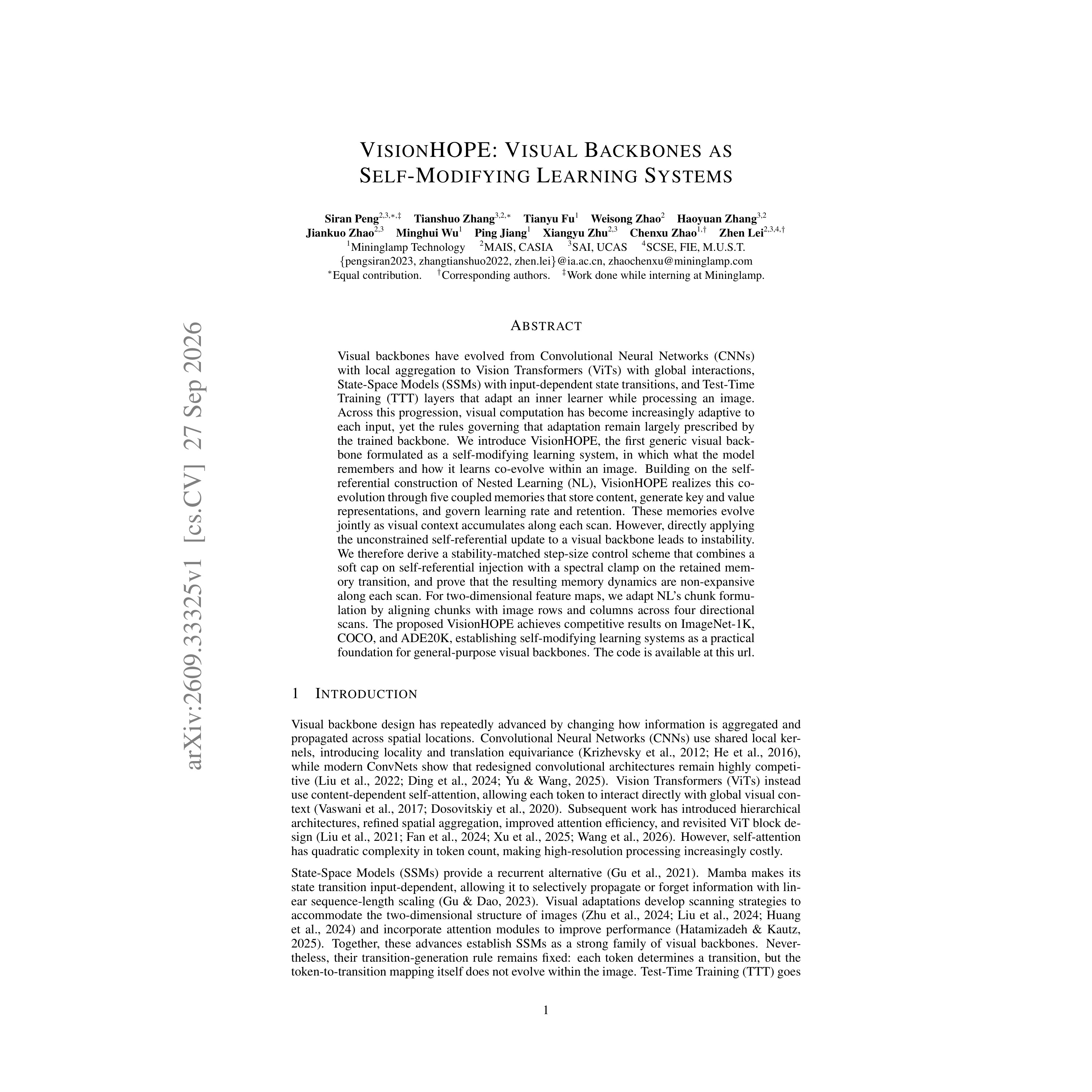
Source cover or first page for VisionHOPE: Visual Backbones as Self-Modifying Learning Systems (Siran Peng et al.)

AI & Computer Science

· Recent research

VisionHOPE: Visual Backbones as Self-Modifying Learning Systems (Siran Peng et al.)

VisionHOPE explores how a vision model can change both its memory and its learning rules while processing an image.

About this episode

Its design connects five memories: content, keys, values, learning rate, and retention.

The paper develops controls that keep these coupled updates stable under the conditions established by its analysis.

Four directional scans adapt the method to the two-dimensional structure of images, with computation scaling linearly in the number of image tokens.

The authors report competitive results on ImageNet classification, COCO object detection, and ADE20K semantic segmentation.

This 2026 preprint connects associative memory and Nested Learning to the design of visual backbones.

Original sourceWorld Models and V-JEPA: Learning from Video (Yann LeCun & Adrien Bardes et al.)Building Machines That Learn and Think Like People (Brenden Lake et al.)
Listen
Source cover or first page for A First Course in Causal Inference (Peng Ding)

Mathematics & Science

· Book deep dive

A First Course in Causal Inference (Peng Ding)

Peng Ding introduces causal inference from a statistical perspective.

About this episode

The book explains the foundations needed to reason about causal effects rather than associations alone.

Examples and applications draw on biostatistics and econometrics.

Mathematical arguments are accompanied by exercises, data, and practical R code.

The course assumes basic probability, statistical inference, and familiarity with regression.

Original sourceGraph Theory (Reinhard Diestel)Lie Groups, Lie Algebras, and Representations (Brian Hall)
Listen
Source cover or first page for Graph Theory (Reinhard Diestel)

Mathematics & Science

Graph Theory (Reinhard Diestel)

Reinhard Diestel’s Graph Theory develops mathematical ways to reason about vertices and the connections between them.

About this episode

The book studies connectivity, matchings, planarity, coloring and flows.

Proofs explain what can and cannot be inferred from a graph’s structure.

The discussion connects the foundations with more advanced parts of the subject.

This is an introduction to the questions behind a mathematical textbook, with the original work available for the definitions and full proofs.

Original sourceLie Groups, Lie Algebras, and Representations (Brian Hall)A First Course in Causal Inference (Peng Ding)
Listen
Source cover or first page for Syntactic Theory: A Formal Introduction (Ivan Sag, Thomas Wasow & Emily Bender)

Language & Linguistics

· Book deep dive

Syntactic Theory: A Formal Introduction (Ivan Sag, Thomas Wasow & Emily Bender)

Ivan Sag, Thomas Wasow and Emily Bender develop ways to describe which sentence structures a grammar permits.

About this episode

Syntactic Theory: A Formal Introduction builds analyses through problems that expose the limits of simpler accounts.

Lexical information and constraints help explain how grammatical structures are licensed.

The book connects syntax with meaning and evidence from language processing.

Its exercises invite readers to compare competing analyses and test what each one predicts.

Original sourceFormal Properties of Grammars (Noam Chomsky)The Sound of Silence: Investigations of Implicit Prosody (Nicholas J. Van Handel)
Listen
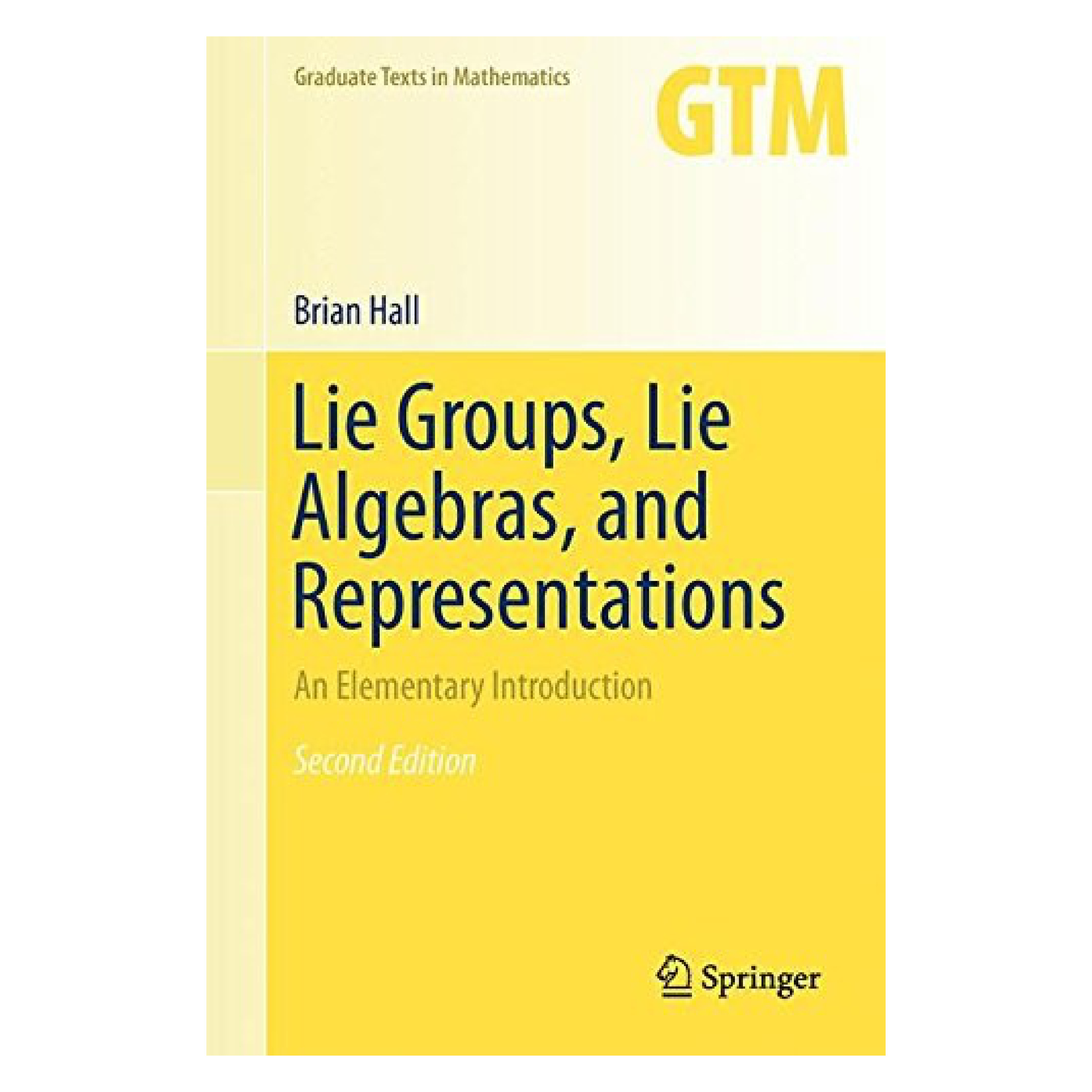
Source cover or first page for Lie Groups, Lie Algebras, and Representations (Brian Hall)

Mathematics & Science

Lie Groups, Lie Algebras, and Representations (Brian Hall)

Brian Hall introduces Lie groups, Lie algebras, and their representations.

About this episode

Matrix groups provide a concrete starting point for the general theory.

The book explains how group structure connects with its infinitesimal algebraic description.

Examples such as SU(2) and SU(3) prepare readers for broader representation-theoretic results.

The material links continuous symmetry with topics used in mathematics and physics.

Original sourceGraph Theory (Reinhard Diestel)A First Course in Causal Inference (Peng Ding)
Listen
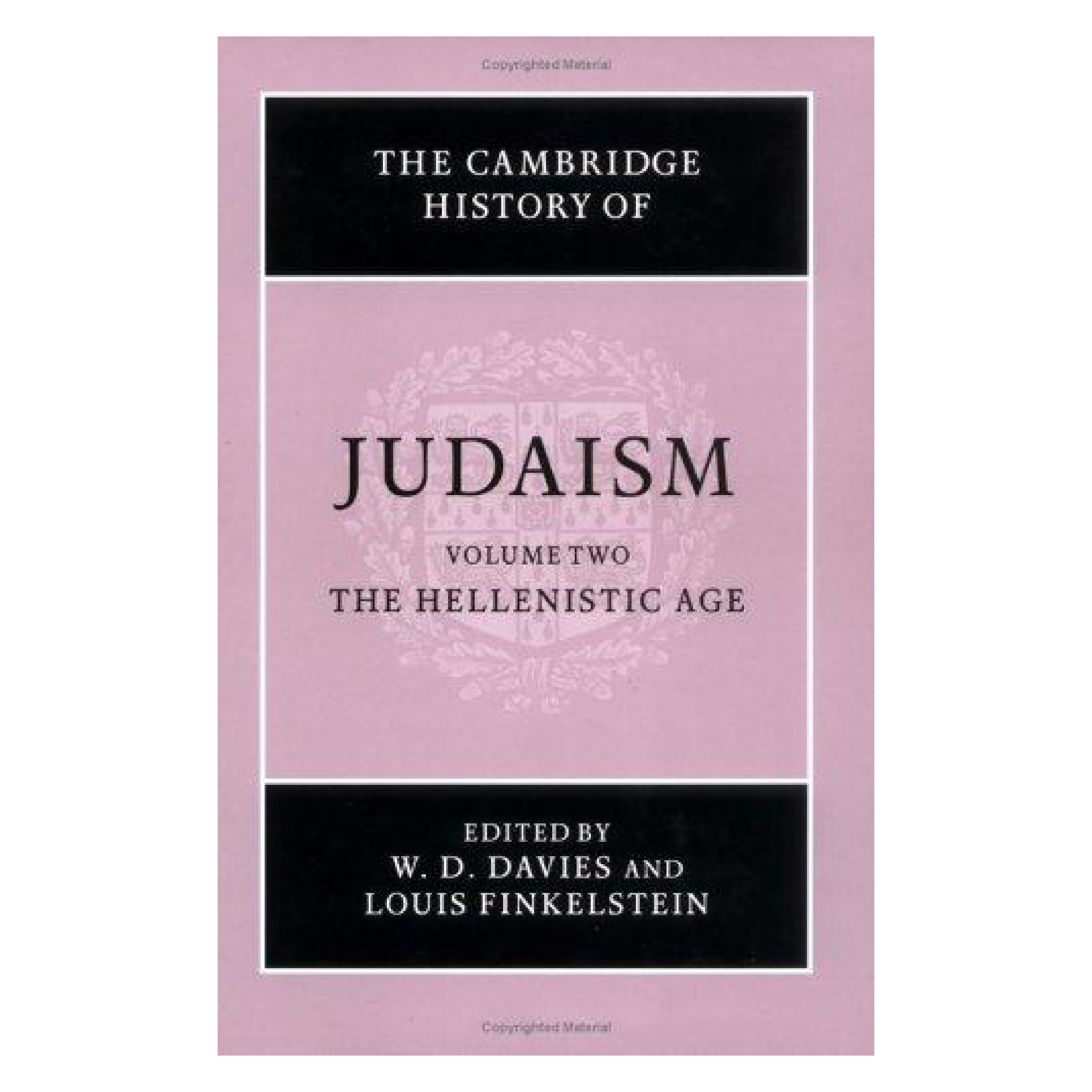
Source cover or first page for Cambridge History of Judaism 2 - The Hellenistic Age 1/2

History & Judaism

Cambridge History of Judaism 2 - The Hellenistic Age 1/2

This volume examines Judaism in the Hellenistic age.

About this episode

It considers encounters between Jewish communities and Greek culture.

Political history accompanies studies of religious and literary change.

The essays trace Jewish life within a changing Mediterranean world.

Original sourceCambridge History of Judaism 1 - The Persian PeriodCambridge History of Judaism 2 - The Hellenistic Age 2/2
Listen
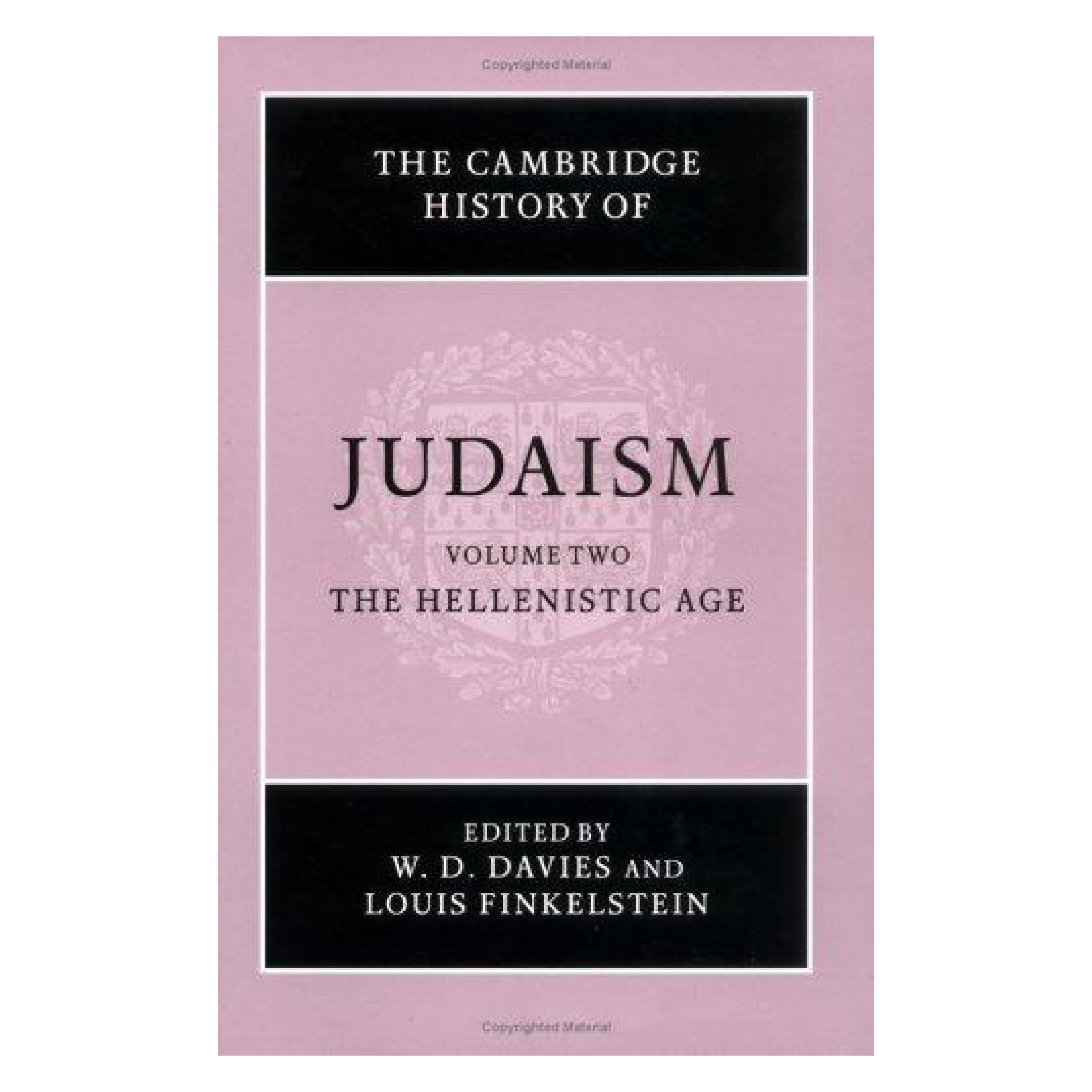
Source cover or first page for Cambridge History of Judaism 2 - The Hellenistic Age 2/2

History & Judaism

Cambridge History of Judaism 2 - The Hellenistic Age 2/2

This volume examines Judaism in the Hellenistic age.

About this episode

It considers encounters between Jewish communities and Greek culture.

Political history accompanies studies of religious and literary change.

The essays trace Jewish life within a changing Mediterranean world.

Original sourceCambridge History of Judaism 2 - The Hellenistic Age 1/2Cambridge History of Judaism 3 - The Early Roman Period 1/4
Listen
Source cover or first page for Cambridge History of Judaism 3 - The Early Roman Period 3/4

History & Judaism

Cambridge History of Judaism 3 - The Early Roman Period 3/4

This volume examines Jewish life under early Roman rule.

About this episode

Its essays cover institutions, communities, and schools of thought.

Archaeology and inscriptions complement the study of written sources.

Christianity is considered within the history of ancient Judaism.

Original sourceCambridge History of Judaism 3 - The Early Roman Period 2/4Cambridge History of Judaism 3 - The Early Roman Period 4/4
Listen
Source cover or first page for Cambridge History of Judaism 3 - The Early Roman Period 2/4

History & Judaism

Cambridge History of Judaism 3 - The Early Roman Period 2/4

This volume examines Jewish life under early Roman rule.

About this episode

Its essays cover institutions, communities, and schools of thought.

Archaeology and inscriptions complement the study of written sources.

Christianity is considered within the history of ancient Judaism.

Original sourceCambridge History of Judaism 3 - The Early Roman Period 1/4Cambridge History of Judaism 3 - The Early Roman Period 3/4
Listen
Source cover or first page for Cambridge History of Judaism 3 - The Early Roman Period 1/4

History & Judaism

Cambridge History of Judaism 3 - The Early Roman Period 1/4

This volume examines Jewish life under early Roman rule.

About this episode

Its essays cover institutions, communities, and schools of thought.

Archaeology and inscriptions complement the study of written sources.

Christianity is considered within the history of ancient Judaism.

Original sourceCambridge History of Judaism 2 - The Hellenistic Age 2/2Cambridge History of Judaism 3 - The Early Roman Period 2/4
Listen
Source cover or first page for Cambridge History of Judaism 3 - The Early Roman Period 4/4

History & Judaism

Cambridge History of Judaism 3 - The Early Roman Period 4/4

This volume examines Jewish life under early Roman rule.

About this episode

Its essays cover institutions, communities, and schools of thought.

Archaeology and inscriptions complement the study of written sources.

Christianity is considered within the history of ancient Judaism.

Original sourceCambridge History of Judaism 3 - The Early Roman Period 3/4Cambridge History of Judaism 4 - The Late Roman - Rabbinic Period 1/4
Listen
Source cover or first page for Cambridge History of Judaism 4 - The Late Roman - Rabbinic Period 3/4

History & Judaism

Cambridge History of Judaism 4 - The Late Roman - Rabbinic Period 3/4

This volume covers Judaism from 70 to 640 CE.

About this episode

It examines the growth of rabbinic institutions and traditions.

The Mishnah, Talmuds, and Midrash receive sustained attention.

The essays place these developments within late Roman Jewish life.

Original sourceCambridge History of Judaism 4 - The Late Roman - Rabbinic Period 2/4Cambridge History of Judaism 4 - The Late Roman - Rabbinic Period 4/4
Listen
Source cover or first page for Cambridge History of Judaism 4 - The Late Roman - Rabbinic Period 4/4

History & Judaism

Cambridge History of Judaism 4 - The Late Roman - Rabbinic Period 4/4

This volume covers Judaism from 70 to 640 CE.

About this episode

It examines the growth of rabbinic institutions and traditions.

The Mishnah, Talmuds, and Midrash receive sustained attention.

The essays place these developments within late Roman Jewish life.

Original sourceCambridge History of Judaism 4 - The Late Roman - Rabbinic Period 3/4Cambridge History of Judaism 5 - Judaism in the Medieval Islamic World 1/3
Listen
Source cover or first page for Cambridge History of Judaism 4 - The Late Roman - Rabbinic Period 2/4

History & Judaism

Cambridge History of Judaism 4 - The Late Roman - Rabbinic Period 2/4

This volume covers Judaism from 70 to 640 CE.

About this episode

It examines the growth of rabbinic institutions and traditions.

The Mishnah, Talmuds, and Midrash receive sustained attention.

The essays place these developments within late Roman Jewish life.

Original sourceCambridge History of Judaism 4 - The Late Roman - Rabbinic Period 1/4Cambridge History of Judaism 4 - The Late Roman - Rabbinic Period 3/4
Listen
Source cover or first page for Cambridge History of Judaism 4 - The Late Roman - Rabbinic Period 1/4

History & Judaism

Cambridge History of Judaism 4 - The Late Roman - Rabbinic Period 1/4

This volume covers Judaism from 70 to 640 CE.

About this episode

It examines the growth of rabbinic institutions and traditions.

The Mishnah, Talmuds, and Midrash receive sustained attention.

The essays place these developments within late Roman Jewish life.

Original sourceCambridge History of Judaism 3 - The Early Roman Period 4/4Cambridge History of Judaism 4 - The Late Roman - Rabbinic Period 2/4
Listen
Source cover or first page for Cambridge History of Judaism 5 - Judaism in the Medieval Islamic World 3/3

History & Judaism

Cambridge History of Judaism 5 - Judaism in the Medieval Islamic World 3/3

This volume follows Jewish communities in the medieval Islamic world.

About this episode

It examines changes in daily life, scholarship, and communal organization.

Islamic expansion reshaped where Jews lived and how they traded.

The essays connect local histories across a broad geographical setting.

Original sourceCambridge History of Judaism 5 - Judaism in the Medieval Islamic World 2/3Cambridge History of Judaism 6 - The Middle Ages: The Christian World 1/3
Listen
Source cover or first page for Cambridge History of Judaism 5 - Judaism in the Medieval Islamic World 1/3

History & Judaism

Cambridge History of Judaism 5 - Judaism in the Medieval Islamic World 1/3

This volume follows Jewish communities in the medieval Islamic world.

About this episode

It examines changes in daily life, scholarship, and communal organization.

Islamic expansion reshaped where Jews lived and how they traded.

The essays connect local histories across a broad geographical setting.

Original sourceCambridge History of Judaism 4 - The Late Roman - Rabbinic Period 4/4Cambridge History of Judaism 5 - Judaism in the Medieval Islamic World 2/3
Listen
Source cover or first page for Cambridge History of Judaism 5 - Judaism in the Medieval Islamic World 2/3

History & Judaism

Cambridge History of Judaism 5 - Judaism in the Medieval Islamic World 2/3

This volume follows Jewish communities in the medieval Islamic world.

About this episode

It examines changes in daily life, scholarship, and communal organization.

Islamic expansion reshaped where Jews lived and how they traded.

The essays connect local histories across a broad geographical setting.

Original sourceCambridge History of Judaism 5 - Judaism in the Medieval Islamic World 1/3Cambridge History of Judaism 5 - Judaism in the Medieval Islamic World 3/3
Listen
Source cover or first page for Cambridge History of Judaism 6 - The Middle Ages: The Christian World 3/3

History & Judaism

Cambridge History of Judaism 6 - The Middle Ages: The Christian World 3/3

This volume examines medieval Jewish life in the Christian world.

About this episode

It follows changes associated with the growth of Western Christendom.

The essays consider Jewish communities and their surrounding societies.

Religious and cultural developments accompany the history of medieval Jewry.

Original sourceCambridge History of Judaism 6 - The Middle Ages: The Christian World 2/3Cambridge History of Judaism 6 - The Middle Ages: The Christian World 1/3
Listen
Source cover or first page for Cambridge History of Judaism 6 - The Middle Ages: The Christian World 1/3

History & Judaism

Cambridge History of Judaism 6 - The Middle Ages: The Christian World 1/3

This volume examines medieval Jewish life in the Christian world.

About this episode

It follows changes associated with the growth of Western Christendom.

The essays consider Jewish communities and their surrounding societies.

Religious and cultural developments accompany the history of medieval Jewry.

Original sourceCambridge History of Judaism 5 - Judaism in the Medieval Islamic World 3/3Cambridge History of Judaism 6 - The Middle Ages: The Christian World 2/3
Listen
Source cover or first page for Cambridge History of Judaism 6 - The Middle Ages: The Christian World 2/3

History & Judaism

Cambridge History of Judaism 6 - The Middle Ages: The Christian World 2/3

This volume examines medieval Jewish life in the Christian world.

About this episode

It follows changes associated with the growth of Western Christendom.

The essays consider Jewish communities and their surrounding societies.

Religious and cultural developments accompany the history of medieval Jewry.

Original sourceCambridge History of Judaism 6 - The Middle Ages: The Christian World 1/3Cambridge History of Judaism 6 - The Middle Ages: The Christian World 3/3
Listen
Source cover or first page for Cambridge History of Judaism 1 - The Persian Period

History & Judaism

Cambridge History of Judaism 1 - The Persian Period

This volume introduces Jewish history under Persian rule.

About this episode

It places the period within the wider history of Judaism.

Historical sources frame questions about Jewish communities and institutions.

The collection establishes the starting point for the Cambridge series.

Original sourceCambridge History of Judaism 2 - The Hellenistic Age 1/2Cambridge History of Judaism 2 - The Hellenistic Age 2/2
Listen
Source cover or first page for World Models and V-JEPA: Learning from Video (Yann LeCun & Adrien Bardes et al.)

AI & Computer Science

World Models and V-JEPA: Learning from Video (Yann LeCun & Adrien Bardes et al.)

Yann LeCun’s proposal for autonomous machine intelligence asks how AI might learn models of the world through observation.

About this episode

This conversation connects his 2022 position paper with the 2024 V-JEPA study by Adrien Bardes and colleagues, including LeCun.

V-JEPA learns by predicting representations of missing video regions rather than reconstructing every pixel.

The paper evaluates those learned representations on image and video recognition tasks.

The episode explores the connection between that learning objective and the broader ambition of building machines that can understand and act in the world.

Original sourceBuilding Machines That Learn and Think Like People (Brenden Lake et al.)Neuromorphic Intelligence: Learning, Architectures and Large-Scale Systems (Shuangming Yang & Badong Chen)
Listen
Source cover or first page for Introduction to Natural Language Processing (Jacob Eisenstein)

AI & Computer Science

· Book deep dive

Introduction to Natural Language Processing (Jacob Eisenstein)

Jacob Eisenstein introduces computational methods for understanding, generating, and manipulating language.

About this episode

The book establishes machine-learning tools before applying them to text analysis.

Sequences, trees, and graphs provide structured representations of linguistic information.

Accounts of meaning range from formal logic to neural word embeddings.

Applications include information extraction, machine translation, and text generation.

Original sourceSpeech and Language Processing (Daniel Jurafsky & James H. Martin) — Part 2Speech and Language Processing (Daniel Jurafsky & James H. Martin) — Part 1
Listen
Source cover or first page for Structure and Interpretation of Computer Programs (Harold Abelson & Gerald Jay Sussman)

AI & Computer Science

· Book deep dive

Structure and Interpretation of Computer Programs (Harold Abelson & Gerald Jay Sussman)

Abelson and Sussman examine how programs are built from reusable ideas and abstractions.

About this episode

Procedures and data abstractions provide ways to organize increasingly complex computations.

The book studies state, evaluation, and the design of interpreters and compilers.

Scheme examples connect programming techniques with models of how computation works.

Its emphasis is on understanding program structure and creating languages for expressing solutions.

Original sourceIntroduction to the Theory of Computation (Michael Sipser)The Information: A History, a Theory, a Flood (James Gleick)
Listen
Source cover or first page for Speech and Language Processing (Daniel Jurafsky & James H. Martin) — Part 2

AI & Computer Science

· Book deep dive

Speech and Language Processing (Daniel Jurafsky & James H. Martin) — Part 2

Jurafsky and Martin survey computational approaches to speech and human language.

About this episode

The book connects linguistic representations with statistical and machine-learning methods.

Its topics range from words and sequences to syntax, meaning, and language understanding.

Applications show how these methods support systems that analyze and generate language.

The text provides a foundation for studying the algorithms and assumptions behind language technology.

Original sourceSpeech and Language Processing (Daniel Jurafsky & James H. Martin) — Part 1Introduction to Natural Language Processing (Jacob Eisenstein)
Listen
Source cover or first page for Speech and Language Processing (Daniel Jurafsky & James H. Martin) — Part 1

AI & Computer Science

· Book deep dive

Speech and Language Processing (Daniel Jurafsky & James H. Martin) — Part 1

Jurafsky and Martin survey computational approaches to speech and human language.

About this episode

The book connects linguistic representations with statistical and machine-learning methods.

Its topics range from words and sequences to syntax, meaning, and language understanding.

Applications show how these methods support systems that analyze and generate language.

The text provides a foundation for studying the algorithms and assumptions behind language technology.

Original sourceSpeech and Language Processing (Daniel Jurafsky & James H. Martin) — Part 2Introduction to Natural Language Processing (Jacob Eisenstein)
Listen
Source cover or first page for Formal Properties of Grammars (Noam Chomsky)

Language & Linguistics

· Book chapter

Formal Properties of Grammars (Noam Chomsky)

Chomsky examines grammars as formal systems that generate the sentences of a language.

About this episode

Restrictions on production rules define different classes of grammars and languages.

The analysis compares their expressive power and the structures their derivations assign.

These distinctions connect linguistic descriptions with automata and the theory of computation.

The work asks which formal properties matter for representing natural-language syntax.

Original sourceSyntactic Theory: A Formal Introduction (Ivan Sag, Thomas Wasow & Emily Bender)Noam Chomsky and Major Debates in Linguistics (The Cambridge Companion to Chomsky)
Listen
Source cover or first page for Introduction to the Theory of Computation (Michael Sipser)

AI & Computer Science

· Book deep dive

Introduction to the Theory of Computation (Michael Sipser)

Michael Sipser introduces the mathematical foundations of computation.

About this episode

Automata and formal languages explain what different computational models can recognize.

Computability theory asks which problems can be solved by algorithms at all.

Complexity theory studies how the required time and memory grow with a problem’s size.

Proofs and examples connect these questions to the capabilities and limits of computers.

Original sourceStructure and Interpretation of Computer Programs (Harold Abelson & Gerald Jay Sussman)The Information: A History, a Theory, a Flood (James Gleick)
Listen
Source cover or first page for The Soundscape: Our Sonic Environment and the Tuning of the World (R. Murray Schafer)

Art & Music

The Soundscape: Our Sonic Environment and the Tuning of the World (R. Murray Schafer)

R. Murray Schafer examines the changing sonic environments in which people live.

About this episode

He follows the transformation from natural and rural sounds to industrial and urban noise.

Listening becomes a way to study how communities experience their surroundings.

The book distinguishes sounds that enrich an environment from those that overwhelm it.

Schafer develops an approach to acoustic design aimed at healthier and more attentive soundscapes.

Original sourceOn Late Style: Music and Literature Against the Grain (Edward Said)Music and the Ineffable (Vladimir Jankélévitch)
Listen
Source cover or first page for Neuromorphic Intelligence: Learning, Architectures and Large-Scale Systems (Shuangming Yang & Badong Chen)

AI & Computer Science

· Book deep dive

Neuromorphic Intelligence: Learning, Architectures and Large-Scale Systems (Shuangming Yang & Badong Chen)

Yang and Chen explain the design of compact, low-power systems inspired by the brain.

About this episode

The book introduces learning algorithms for spiking neural networks.

Its approaches include multi-compartment models and methods grounded in information theory.

Architecture design connects these learning methods to scalable neuromorphic computation.

Large digital systems and application examples show how the ideas can be implemented.

Original sourceWorld Models and V-JEPA: Learning from Video (Yann LeCun & Adrien Bardes et al.)Building Machines That Learn and Think Like People (Brenden Lake et al.)
Listen
Source cover or first page for The Illusion of Conscious Will (Daniel M. Wegner)

Mind & Psychology

The Illusion of Conscious Will (Daniel M. Wegner)

Daniel Wegner investigates the feeling that we consciously cause our actions.

About this episode

He argues that this experience of willing is itself produced by psychological and neural processes.

Cases of mistaken authorship help distinguish the feeling of control from what causes behavior.

The book examines why conscious will can feel convincing even when that feeling misleads us.

Wegner also considers its role in self-understanding, responsibility, and morality.

Original sourceEvolutionary Psychology and Development (Palacios et al.)Human Nature (D. W. Winnicott)
Listen
Source cover or first page for Chaim Soutine: Genius, Obsession, and a Dramatic Life in Art (Celeste Marcus)

Art & Music

Chaim Soutine: Genius, Obsession, and a Dramatic Life in Art (Celeste Marcus)

Celeste Marcus revisits the life and work of the Jewish expressionist painter Chaim Soutine.

About this episode

Chaim Soutine: Genius, Obsession, and a Dramatic Life in Art follows his path from eastern Europe to Paris.

The biography examines stories that have shaped the reception of his paintings.

Marcus questions the myths surrounding the artist and his work.

The book invites a reconsideration of how an artist’s reputation can influence what viewers see in the paintings.

Original sourceRembrandt's Eyes (Simon Schama)Rembrandt's Jews (Steven Nadler)
Listen
Source cover or first page for Memory, History, Forgetting (Paul Ricoeur): Memory and Historical Truth

Philosophy & Critical Theory

Memory, History, Forgetting (Paul Ricoeur): Memory and Historical Truth

Paul Ricoeur examines how remembering and forgetting shape our relationship with the past.

About this episode

The first part investigates memory and the experience of recalling what is no longer present.

The second considers historical knowledge and the truth claims of historical writing.

The final part explores forgetting as both a loss and a condition of remembering.

The book asks how these processes influence historical experience and collective remembrance.

Original sourceTime and Narrative (Paul Ricoeur): How Stories Shape TimeHistoriography (Mandelbaum, Burke, Skinner, Geertz)
Listen
Source cover or first page for On Late Style: Music and Literature Against the Grain (Edward Said)

Art & Music

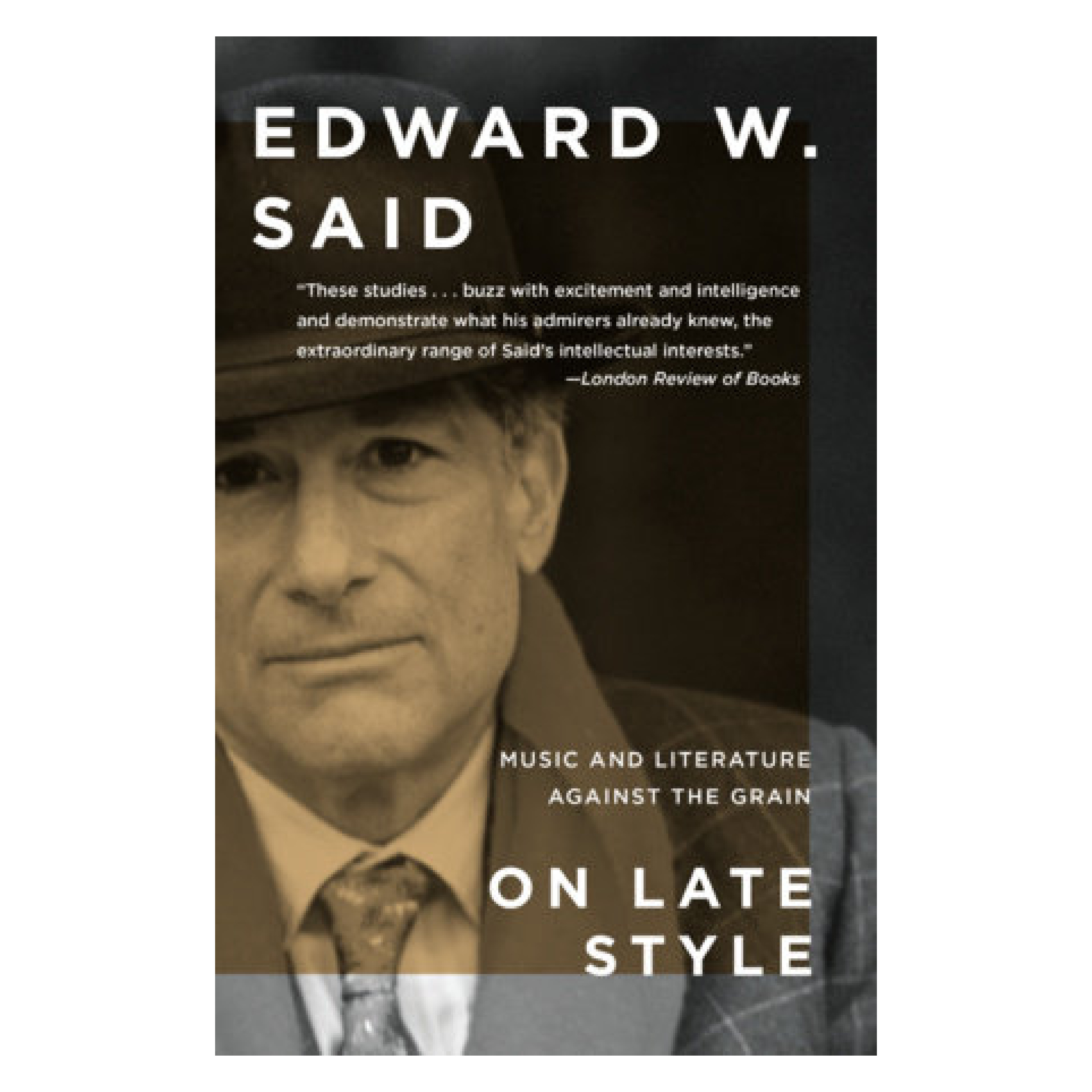
On Late Style: Music and Literature Against the Grain (Edward Said)

Edward Said examines the tensions that distinguish the late work of writers and composers.

About this episode

He considers how approaching death can enter an artist’s choices and forms of expression.

Examples from literature and music reveal unresolved conflicts rather than a single pattern of maturity.

These works can resist the expectations and prevailing tastes of their time.

The book connects artistic lateness with contradiction, difficulty, and the persistence of creative work.

Original sourceMusic and the Ineffable (Vladimir Jankélévitch)The Soundscape: Our Sonic Environment and the Tuning of the World (R. Murray Schafer)
Listen
Source cover or first page for Time and Narrative (Paul Ricoeur): How Stories Shape Time

Philosophy & Critical Theory

Time and Narrative (Paul Ricoeur): How Stories Shape Time

Paul Ricoeur explores how stories connect the time we measure with the time we experience.

About this episode

Time and Narrative brings Augustine’s reflections on time into conversation with Aristotle’s account of plot.

Historical writing and fiction offer different ways of making events intelligible.

The discussion follows how narrative organizes experience and how readers interpret it.

Use these ideas to consider how the stories we tell shape our understanding of a life and its history.

Original sourceMemory, History, Forgetting (Paul Ricoeur): Memory and Historical TruthEichmann vs. Arendt - Against the Banality of Evil
Listen
Source cover or first page for Music and the Ineffable (Vladimir Jankélévitch)

Art & Music

Music and the Ineffable (Vladimir Jankélévitch)

Vladimir Jankélévitch asks how music can express meaning without translating into definite statements.

About this episode

He examines the relationship between musical experience, feeling, and philosophical interpretation.

Music’s effects on listeners exceed what a fixed verbal explanation can capture.

Its temporal movement and ambiguity allow different forms of resonance and response.

The book considers how to think about music while respecting what remains ineffable.

Original sourceOn Late Style: Music and Literature Against the Grain (Edward Said)The Soundscape: Our Sonic Environment and the Tuning of the World (R. Murray Schafer)
Listen
Source cover or first page for Rembrandt's Eyes (Simon Schama)

Art & Music

Rembrandt's Eyes (Simon Schama)

Simon Schama reconstructs Rembrandt’s life through close attention to his pictures.

About this episode

The book connects artistic choices with the people, institutions, and pressures around him.

Portraits and other works become evidence for understanding the painter’s ambitions and experience.

Schama situates Rembrandt within the cultural world of the seventeenth-century Netherlands.

The biography asks what looking carefully at the art can reveal about its maker.

Original sourceChaim Soutine: Genius, Obsession, and a Dramatic Life in Art (Celeste Marcus)Rembrandt's Jews (Steven Nadler)
Listen
Source cover or first page for Spinoza's Ethics: An Introduction (Steven Nadler)

Philosophy & Critical Theory

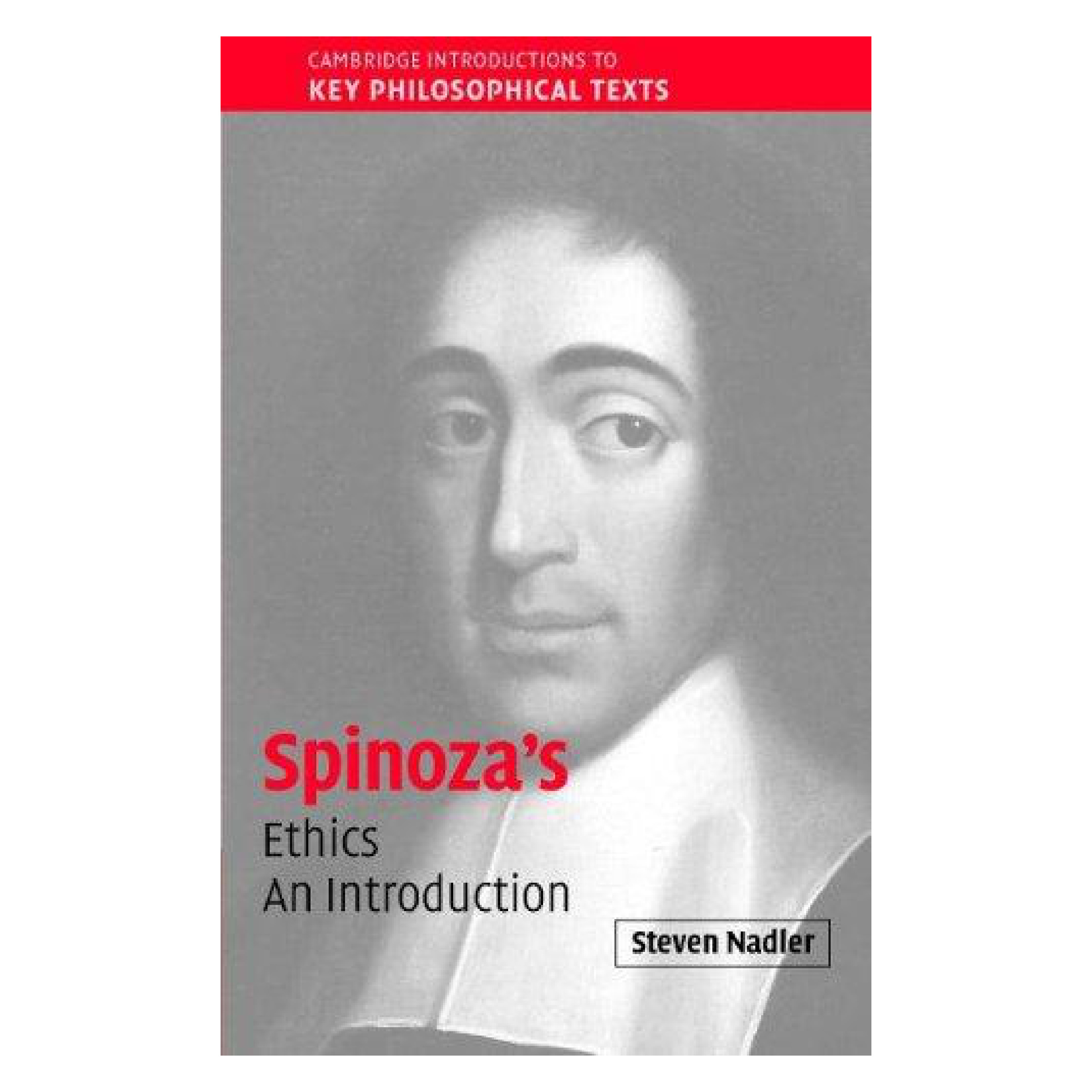
Spinoza's Ethics: An Introduction (Steven Nadler)

Steven Nadler guides readers through Spinoza’s Ethics and its geometric style of argument.

About this episode

He explains the work’s claims about God, nature, human beings, and knowledge.

The discussion follows Spinoza’s account of emotions, virtue, freedom, and happiness.

Historical context connects these arguments to Descartes, ancient philosophy, and Jewish rationalism.

Nadler shows why the Ethics challenged its first readers and still raises philosophical questions.

Original sourceEichmann vs. Arendt - Against the Banality of EvilRembrandt's Jews (Steven Nadler)
Listen
Source cover or first page for Rembrandt's Jews (Steven Nadler)

Art & Music

Rembrandt's Jews (Steven Nadler)

Steven Nadler investigates Rembrandt’s relationship with the Jewish communities of seventeenth-century Amsterdam.

About this episode

He examines portraits, neighbors, daily encounters, and the setting in which the artist worked.

Sephardic and Ashkenazic histories help explain the diversity of Jewish life in the city.

The book tests romantic stories about Rembrandt against the available historical evidence.

Art and urban history together provide a more specific picture of his Jewish surroundings.

Original sourceChaim Soutine: Genius, Obsession, and a Dramatic Life in Art (Celeste Marcus)Rembrandt's Eyes (Simon Schama)
Listen
Source cover or first page for The Information: A History, a Theory, a Flood (James Gleick)

Mathematics & Science

· Book deep dive

The Information: A History, a Theory, a Flood (James Gleick)

James Gleick traces the development of information as a scientific and cultural idea.

About this episode

The history moves from older systems of communication to modern information theory.

It examines how messages can be represented, transmitted, measured, and distorted.

Technological changes reshape the ways people preserve knowledge and communicate across distance.

The book connects these developments to the growing abundance of information in everyday life.

Original sourceStructure and Interpretation of Computer Programs (Harold Abelson & Gerald Jay Sussman)Introduction to the Theory of Computation (Michael Sipser)
Listen
Source cover or first page for Human Nature (D. W. Winnicott)

Mind & Psychology

Human Nature (D. W. Winnicott)

Winnicott brings together his account of emotional development and psychoanalytic theory.

About this episode

The book examines relationships between the body, the psyche, and the mind.

It follows the development of integration, a sense of self, and contact with external reality.

Early relationships and the environment form part of this account of health and disturbance.

The unfinished work offers an overview of ideas otherwise spread across his clinical writings.

Original sourceEvolutionary Psychology and Development (Palacios et al.)Thought and Language (Lev Vygotsky)
Listen
Source cover or first page for Building Machines That Learn and Think Like People (Brenden Lake et al.)

AI & Computer Science

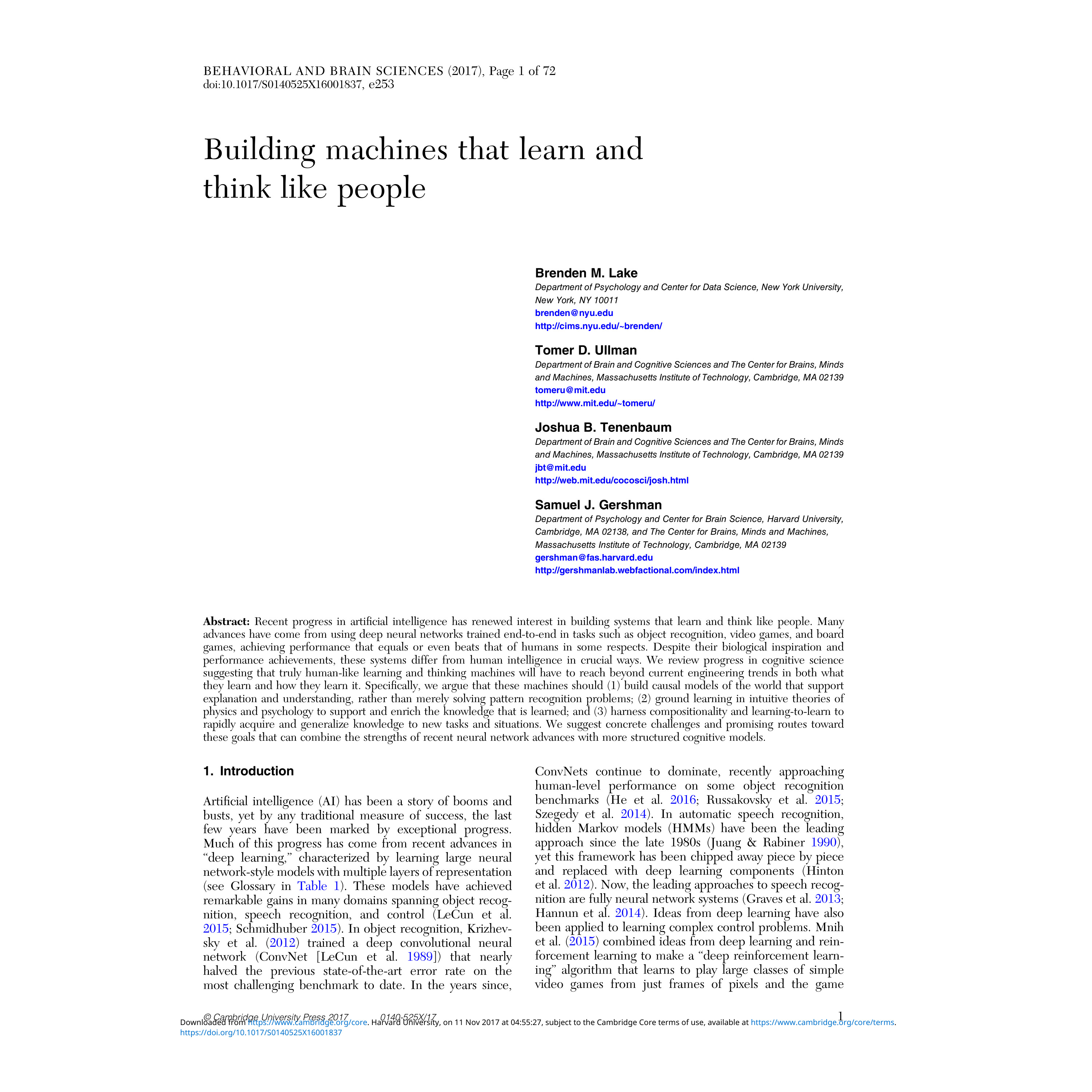
Building Machines That Learn and Think Like People (Brenden Lake et al.)

Lake and colleagues ask what artificial intelligence can learn from human learning and thought.

About this episode

They argue that strong pattern recognition alone does not reproduce human intelligence.

Causal models and intuitive accounts of physics and psychology can support richer understanding.

Compositional representations and learning-to-learn help explain rapid adaptation from limited experience.

The paper proposes research directions that combine neural networks with structured cognitive models.

Original sourceBayesian Models of Cognition: Reverse Engineering the Mind (Thomas Griffiths, Nick Chater & Joshua Tenenbaum)World Models and V-JEPA: Learning from Video (Yann LeCun & Adrien Bardes et al.)
Listen
Source cover or first page for The View from Nowhere (Thomas Nagel)

Philosophy & Critical Theory

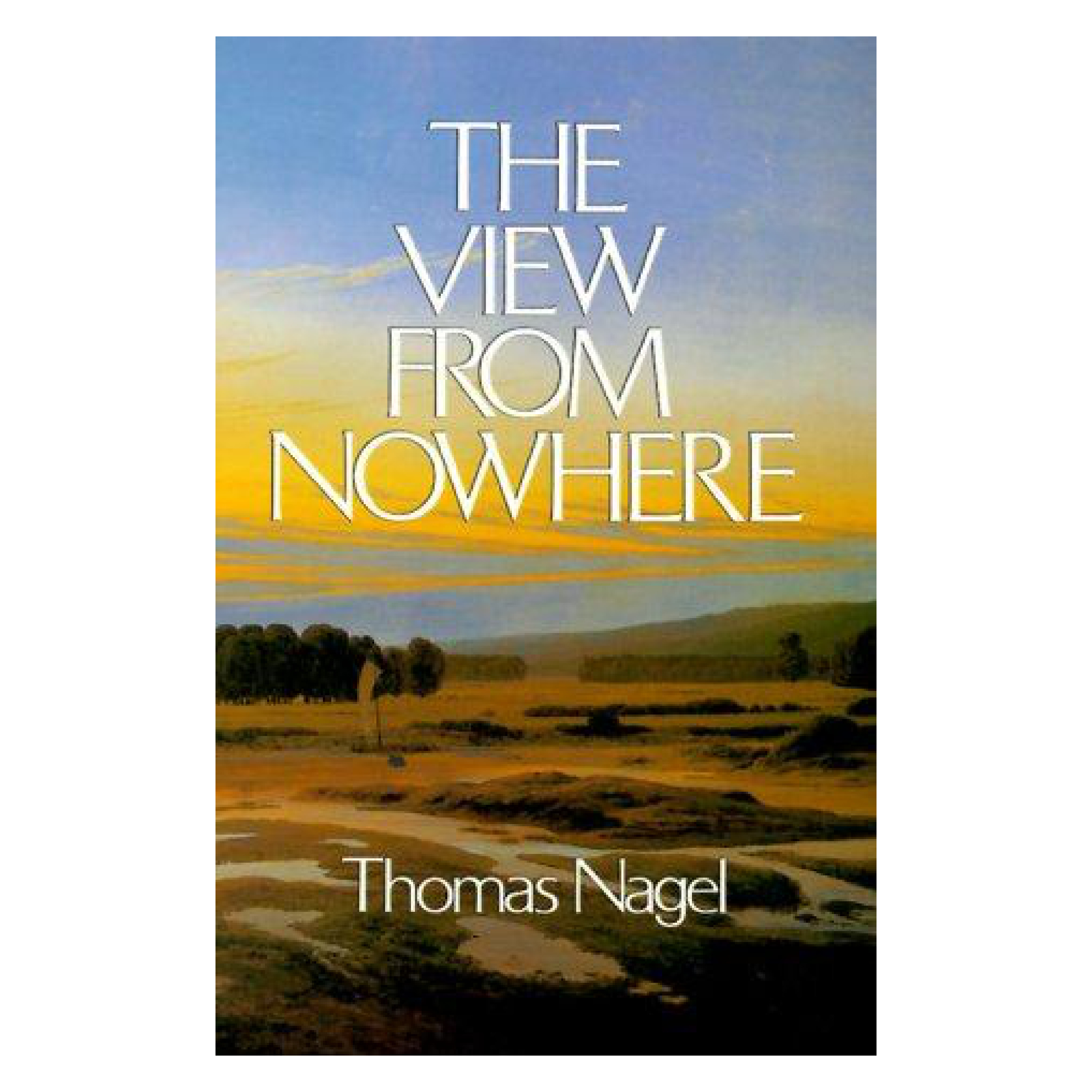
The View from Nowhere (Thomas Nagel)

Thomas Nagel examines the tension between personal experience and an objective view of the world.

About this episode

He asks how a person’s particular standpoint can fit within an account that includes everyone.

This problem appears in questions about consciousness, knowledge, freedom, and ethics.

Greater detachment can reveal some features of reality while obscuring others.

The book investigates how subjective and objective perspectives might be reconciled without erasing either.

Original sourceEichmann vs. Arendt - Against the Banality of EvilMemory, History, Forgetting (Paul Ricoeur): Memory and Historical Truth
Listen
Source cover or first page for Minima Moralia: Reflections from Damaged Life (Theodor Adorno) — Full Discussion

Philosophy & Critical Theory

Minima Moralia: Reflections from Damaged Life (Theodor Adorno) — Full Discussion

Adorno examines modern society through aphorisms and reflections on everyday life.

About this episode

Written in exile, the work connects private experience with capitalism and historical catastrophe.

Its subjects include morality, relationships, culture, intellectual work, and damaged autonomy.

Small observations reveal how social pressures reach into seemingly personal choices.

The book uses critical reflection to test the possibility of a less damaged life.

Original sourceMinima Moralia: Reflections from Damaged Life (Theodor Adorno)A Precarious Happiness: Adorno and the Sources of Normativity (Peter E. Gordon)
Listen
Source cover or first page for Confronting Antisemitism: Fighting Antisemitism Today (Theodor Adorno)

Philosophy & Critical Theory

Confronting Antisemitism: Fighting Antisemitism Today (Theodor Adorno)

In this 1962 lecture, Adorno examines the persistence of antisemitism after the Holocaust.

About this episode

He connects anti-Jewish prejudice with authoritarian attitudes, conformity, and right-wing extremism.

The lecture considers how prejudice can survive through denial and claims of victimhood.

Adorno distinguishes sustained educational work from the immediate need to confront established hostility.

He argues for truthful engagement with history and attention to the social mechanisms of prejudice.

Original sourceMigrants in the Profane: Critical Theory and the Question of Secularization (Peter E. Gordon)Minima Moralia: Reflections from Damaged Life (Theodor Adorno) — Full Discussion
Listen
Source cover or first page for Rosenzweig and Heidegger: Between Judaism and German Philosophy (Peter E. Gordon)

Philosophy & Critical Theory

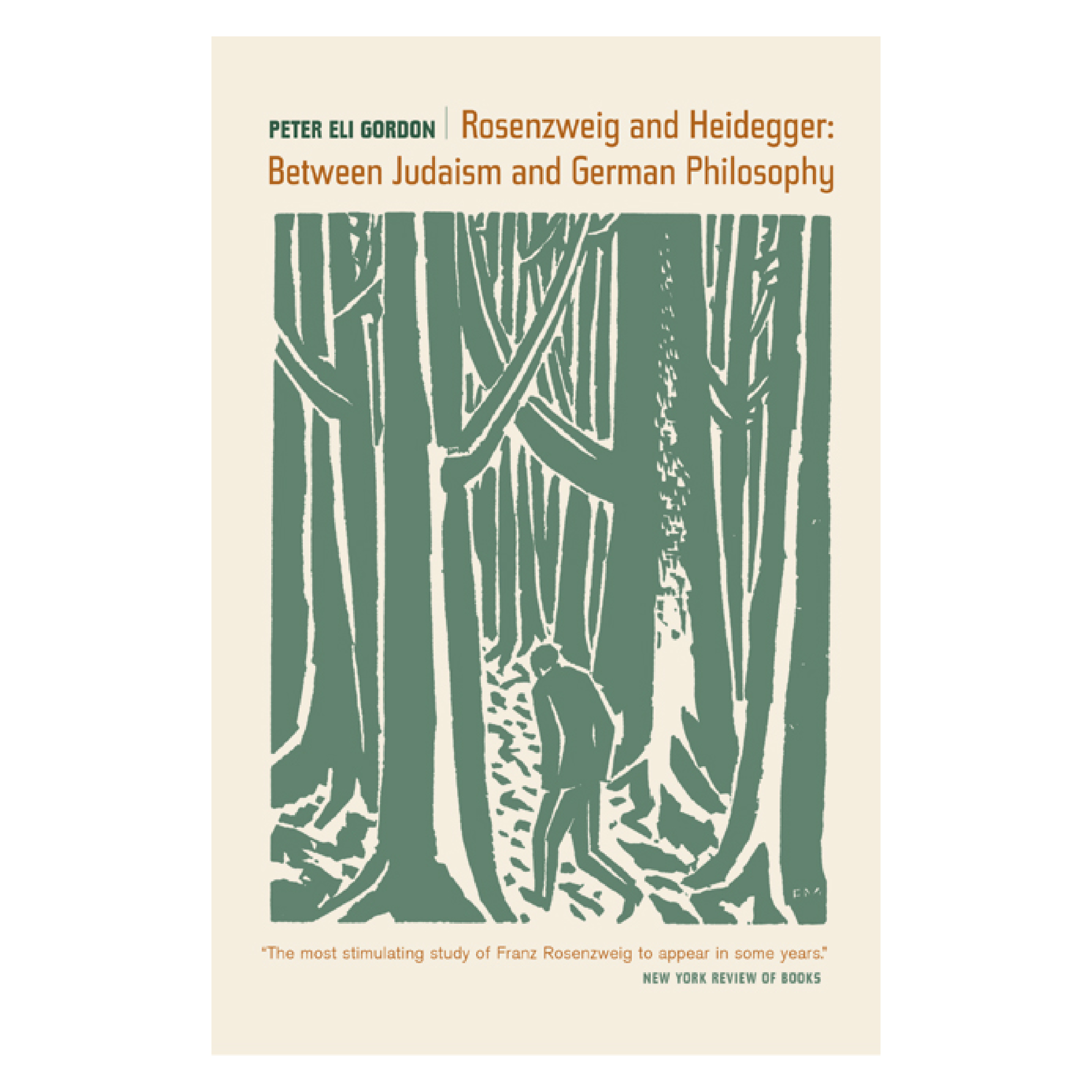
Rosenzweig and Heidegger: Between Judaism and German Philosophy (Peter E. Gordon)

Peter Gordon places Rosenzweig and Heidegger within a shared German philosophical setting.

About this episode

He rereads The Star of Redemption alongside the questions that shaped Heidegger’s work.

Temporality, finitude, and existence connect their responses to inherited philosophical systems.

The comparison also considers Rosenzweig’s relationships to Hegel and neo-Kantian thought.

Gordon examines intellectual affinities while keeping their profound political and religious differences in view.

Original sourceMigrants in the Profane: Critical Theory and the Question of Secularization (Peter E. Gordon)Adorno and Existence (Peter E. Gordon)
Listen
Source cover or first page for The Concept of God After Auschwitz: A Jewish Voice (Hans Jonas)

Philosophy & Critical Theory

The Concept of God After Auschwitz: A Jewish Voice (Hans Jonas)

Hans Jonas confronts the theological challenge posed by Auschwitz.

About this episode

He questions whether divine goodness, intelligibility, and omnipotence can all be maintained after the Holocaust.

His speculative account imagines a God who relinquishes unrestricted power in creating the world.

This God suffers and cares but cannot simply intervene to prevent human evil.

The argument places responsibility for what happens in the world more firmly on human beings.

Original sourceEichmann vs. Arendt - Against the Banality of EvilRosenzweig and Heidegger: Between Judaism and German Philosophy (Peter E. Gordon)
Listen
Source cover or first page for Adorno and Existence (Peter E. Gordon)

Philosophy & Critical Theory

Adorno and Existence (Peter E. Gordon)

Peter Gordon examines Adorno’s sustained engagement with existentialism and phenomenology.

About this episode

He follows Adorno’s criticisms of Kierkegaard, Husserl, and Heidegger across his career.

These encounters help explain how Adorno developed his own materialist philosophy.

The discussion includes his objections to authenticity and the idealization of inward subjectivity.

Gordon shows how criticism could coexist with a lasting intellectual bond to these traditions.

Original sourceA Precarious Happiness: Adorno and the Sources of Normativity (Peter E. Gordon)Migrants in the Profane: Critical Theory and the Question of Secularization (Peter E. Gordon)
Listen
Source cover or first page for Migrants in the Profane: Critical Theory and the Question of Secularization (Peter E. Gordon)

Philosophy & Critical Theory

Migrants in the Profane: Critical Theory and the Question of Secularization (Peter E. Gordon)

Peter Gordon asks whether religious ideas can retain critical value in secular political life.

About this episode

The book examines this question through Benjamin, Horkheimer, and Adorno.

Their work explores how theological concepts change as they enter a profane world.

Gordon considers the relationship between secularization, social criticism, and hopes for justice.

The inquiry asks which religious resources can survive transformation without retaining religious authority.

Original sourceAdorno and Existence (Peter E. Gordon)Confronting Antisemitism: Fighting Antisemitism Today (Theodor Adorno)
Listen
Source cover or first page for German Jews: A Dual Identity (Paul Mendes-Flohr)

History & Judaism

German Jews: A Dual Identity (Paul Mendes-Flohr)

Paul Mendes-Flohr examines the combined Jewish and German inheritance of German-Jewish culture.

About this episode

Franz Rosenzweig’s image of a land of two rivers frames the discussion.

The book explores cultural affiliation, assimilation, and the tensions of belonging to more than one tradition.

German cultural participation did not necessarily bring full acceptance within German society.

This history offers a broader account of the challenges of living with plural identities.

Original sourceCambridge History of Judaism - Topics: Jews of LithuaniaCambridge History of Judaism 2 - The Hellenistic Age 1/2
Listen
Source cover or first page for The Sound of Silence: Investigations of Implicit Prosody (Nicholas J. Van Handel)

Language & Linguistics

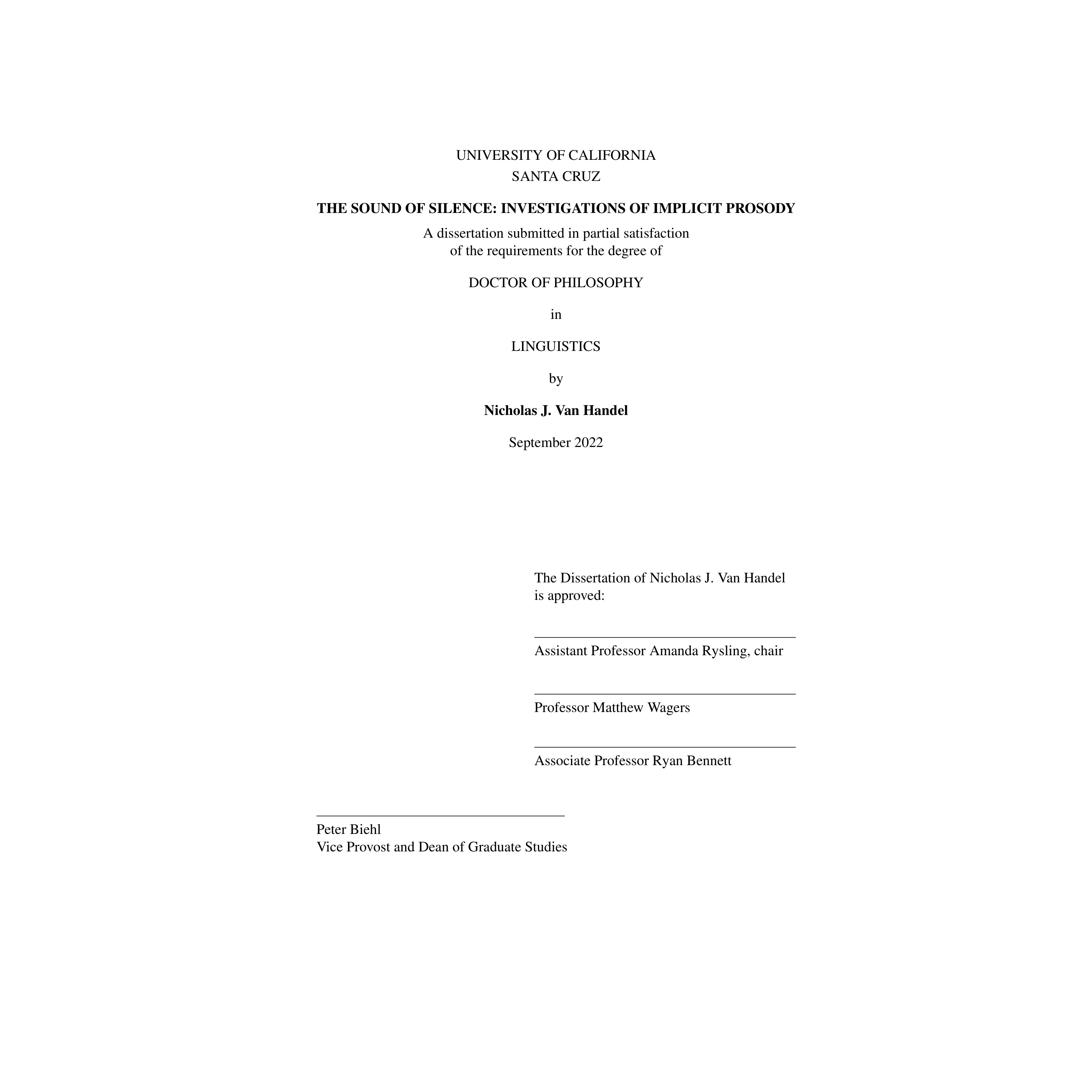
The Sound of Silence: Investigations of Implicit Prosody (Nicholas J. Van Handel)

Nicholas Van Handel studies the prosodic structure readers assign during silent reading.

About this episode

The dissertation compares Maze tasks and self-paced reading as methods for investigating implicit prosody.

Its experiments examine how mentally supplied rhythm and phrasing affect sentence processing.

The findings support the Maze task’s sensitivity and its more localized processing effects.

The work also outlines how grammatical principles could guide incremental prosodic parsing.

Original sourceOptimality Theory (René Kager)Phonological Tone (Moira Yip)
Listen
Source cover or first page for A Precarious Happiness: Adorno and the Sources of Normativity (Peter E. Gordon)

Philosophy & Critical Theory

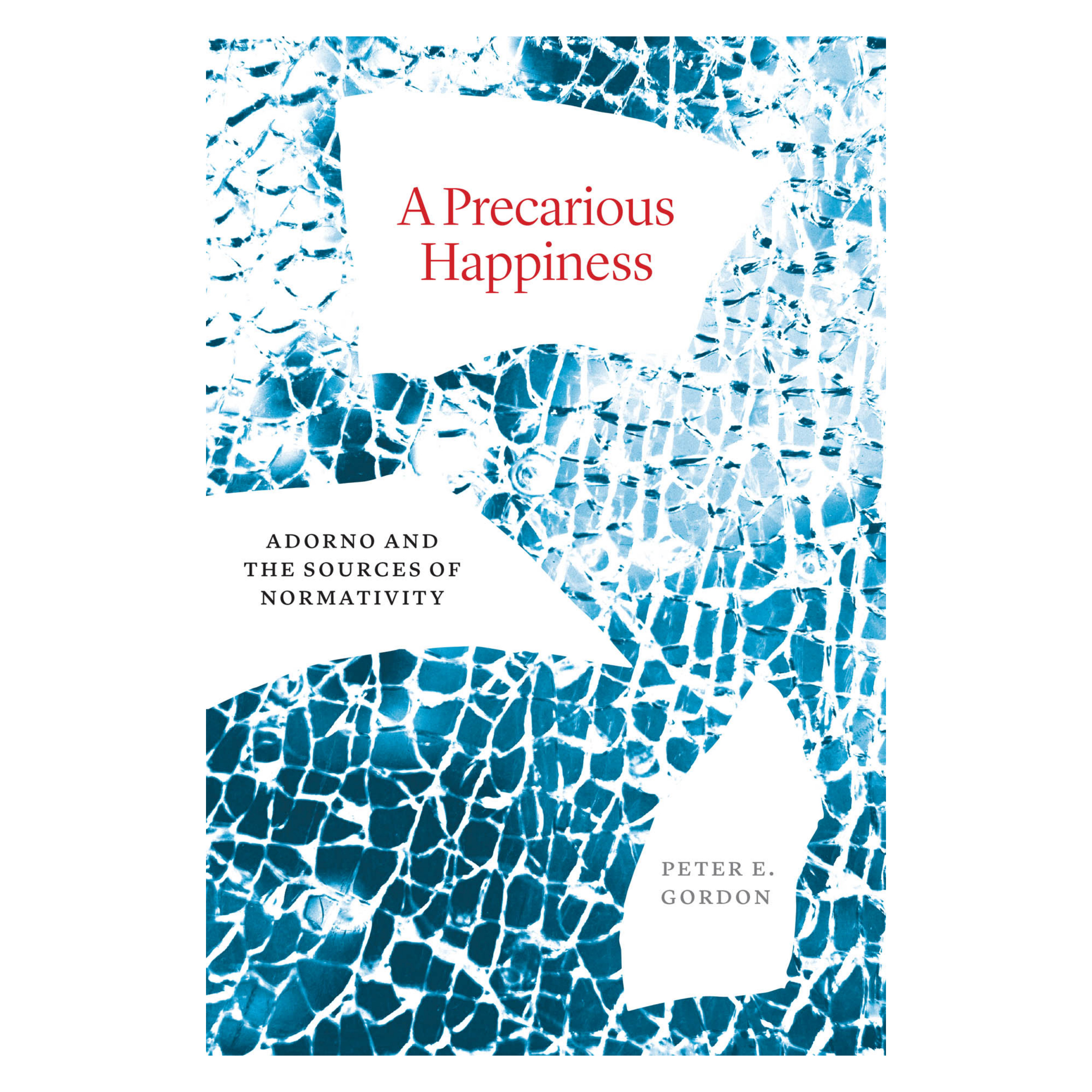
A Precarious Happiness: Adorno and the Sources of Normativity (Peter E. Gordon)

Peter E. Gordon challenges the image of Theodor Adorno as a philosopher of unqualified despair.

About this episode

In A Precarious Happiness: Adorno and the Sources of Normativity, he argues that criticism of a damaged society can still be guided by possibilities for a better life.

The book examines fragments of happiness and human flourishing within Adorno’s philosophy and aesthetics.

These possibilities help explain the standards behind Adorno’s social criticism.

The central question is what gives a critique its force when the world it criticizes is also the source of its values.

Original sourceMinima Moralia: Reflections from Damaged Life (Theodor Adorno) — Full DiscussionAdorno and Existence (Peter E. Gordon)
Listen
Source cover or first page for Minima Moralia: Reflections from Damaged Life (Theodor Adorno)

Philosophy & Critical Theory

Minima Moralia: Reflections from Damaged Life (Theodor Adorno)

Adorno examines modern society through aphorisms and reflections on everyday life.

About this episode

Written in exile, the work connects private experience with capitalism and historical catastrophe.

Its subjects include morality, relationships, culture, intellectual work, and damaged autonomy.

Small observations reveal how social pressures reach into seemingly personal choices.

The book uses critical reflection to test the possibility of a less damaged life.

Original sourceTheodor W. Adorno: One Last Genius (Detlev Claussen)Minima Moralia: Reflections from Damaged Life (Theodor Adorno) — Full Discussion
Listen
Source cover or first page for Theodor W. Adorno: One Last Genius (Detlev Claussen)

Philosophy & Critical Theory

Theodor W. Adorno: One Last Genius (Detlev Claussen)

Detlev Claussen traces Adorno’s life through the upheavals of twentieth-century Europe.

About this episode

The biography connects his Frankfurt upbringing and musical education with his intellectual development.

Exile and the catastrophe of Nazism shape the account of his work and relationships.

Benjamin, Horkheimer, and other contemporaries help place critical theory in its historical setting.

Claussen examines how Adorno’s experiences informed his reflections on culture and modern society.

Original sourceMinima Moralia: Reflections from Damaged Life (Theodor Adorno)Minima Moralia: Reflections from Damaged Life (Theodor Adorno) — Full Discussion
Listen
Source cover or first page for Feeling and Form: A Theory of Art (Susanne Langer)

Art & Music

Feeling and Form: A Theory of Art (Susanne Langer)

Susanne Langer develops a theory of art as the symbolic expression of human feeling.

About this episode

She distinguishes artistic forms from the discursive symbols used in ordinary language and science.

Painting, music, dance, and literature create different kinds of imagined space, time, and experience.

These forms make patterns of feeling available without reducing them to literal statements.

The book treats artworks as expressive structures rather than records of an artist’s personal emotions.

Original sourceChaim Soutine: Genius, Obsession, and a Dramatic Life in Art (Celeste Marcus)On Late Style: Music and Literature Against the Grain (Edward Said)
Listen
Source cover or first page for Thought and Language (Lev Vygotsky)

Mind & Psychology

Thought and Language (Lev Vygotsky)

Vygotsky examines how thought and language develop through childhood.

About this episode

He argues that speech begins in social interaction and can become internalized verbal thought.

The book investigates the changing relationship between word meaning and consciousness.

It connects concept formation with children’s everyday experience and school instruction.

Language provides a central route into his account of higher mental functions.

Original sourceEvolutionary Psychology and Development (Palacios et al.)Human Nature (D. W. Winnicott)
Listen
Source cover or first page for Optimality Theory (René Kager)

Language & Linguistics

Optimality Theory (René Kager)

René Kager introduces a theory in which linguistic forms emerge from competing constraints.

About this episode

An optimal candidate has the least serious violations under a language’s constraint ranking.

Different rankings help explain why languages show different patterns.

The book develops analyses of phonology, morphology, syllables, and reduplication.

It also considers how grammars are learned and how the framework extends to syntax.

Original sourceOptimality Theory (René Kager)The Sound of Silence: Investigations of Implicit Prosody (Nicholas J. Van Handel)
Listen
Source cover or first page for Phonological Tone (Moira Yip)

Language & Linguistics

Phonological Tone (Moira Yip)

Moira Yip explains how languages use pitch to distinguish meaning.

About this episode

The book introduces tonal systems, their phonetic properties, and their formal analysis.

Examples from Africa, Asia, and the Americas show how varied these systems can be.

Yip examines how tone interacts with morphology, syntax, stress, and intonation.

The discussion also considers the perception and acquisition of tone.

Original sourceThe Sound of Silence: Investigations of Implicit Prosody (Nicholas J. Van Handel)Optimality Theory (René Kager)
Listen
Source cover or first page for Optimality Theory (René Kager)

Language & Linguistics

Optimality Theory (René Kager)

René Kager introduces a theory in which linguistic forms emerge from competing constraints.

About this episode

An optimal candidate has the least serious violations under a language’s constraint ranking.

Different rankings help explain why languages show different patterns.

The book develops analyses of phonology, morphology, syllables, and reduplication.

It also considers how grammars are learned and how the framework extends to syntax.

Original sourceOptimality Theory (René Kager)The Sound of Silence: Investigations of Implicit Prosody (Nicholas J. Van Handel)
Listen
Source cover or first page for Language Evolution (Morten Christiansen and Tecumseh Fitch)

Language & Linguistics

Language Evolution (Morten Christiansen and Tecumseh Fitch)

These works examine how human language evolved and why other species lack equivalent capacities.

About this episode

They bring together evidence from linguistics, evolutionary biology, neuroscience, and animal communication.

Language is analyzed through its components rather than treated as a single unexplained ability.

Competing proposals consider gradual change, biological inheritance, and possible forms of protolanguage.

The discussion connects the origins of speech and syntax to broader questions about human cognition.

Original sourceParole et musique: Speech and Music (Stanislas Dehaene & Christine Petit)Evolutionary Psychology and Development (Palacios et al.)
Listen
Source cover or first page for Noam Chomsky and Major Debates in Linguistics (The Cambridge Companion to Chomsky)

Language & Linguistics

Noam Chomsky and Major Debates in Linguistics (The Cambridge Companion to Chomsky)

This collection surveys Chomsky’s contributions to linguistics, the study of mind, and political criticism.

About this episode

Its linguistic chapters examine the language faculty and the biological-minimalist program.

Other contributions discuss how mental capacities can be investigated and explained.

The political chapters consider capitalism, media, foreign policy, and the Palestine–Israel conflict.

The volume places these debates within the wider development of Chomsky’s thought.

Original sourceFormal Properties of Grammars (Noam Chomsky)Introduction to Natural Language Processing (Jacob Eisenstein)
Listen
Source cover or first page for Bayesian Models of Cognition: Reverse Engineering the Mind (Thomas Griffiths, Nick Chater & Joshua Tenenbaum)

Mind & Psychology

· Book deep dive

Bayesian Models of Cognition: Reverse Engineering the Mind (Thomas Griffiths, Nick Chater & Joshua Tenenbaum)

Griffiths, Chater, and Tenenbaum explain cognition through probabilistic models of learning and inference.

About this episode

They ask how people draw useful conclusions from limited and uncertain evidence.

Bayesian inference combines prior knowledge with observations to compare possible explanations.

The book develops mathematical tools and connects them to findings from psychology.

Its applications examine causal reasoning, language, intuitive physics, and resource-limited thought.

Original sourceBuilding Machines That Learn and Think Like People (Brenden Lake et al.)Neuromorphic Intelligence: Learning, Architectures and Large-Scale Systems (Shuangming Yang & Badong Chen)
Listen
Source cover or first page for Parole et musique: Speech and Music (Stanislas Dehaene & Christine Petit)

Language & Linguistics

Parole et musique: Speech and Music (Stanislas Dehaene & Christine Petit)

This collection examines how speech and music shape human communication and social life.

About this episode

Its contributors ask how these capacities evolved and how the brain processes them.

Acoustics, linguistics, psychology, and neuroscience provide different approaches to the shared questions.

The chapters compare musical and linguistic sounds, perception, and forms of expression.

The volume grew from a 2008 conference at the Collège de France.

Original sourceLanguage Evolution (Morten Christiansen and Tecumseh Fitch)The Soundscape: Our Sonic Environment and the Tuning of the World (R. Murray Schafer)
Listen
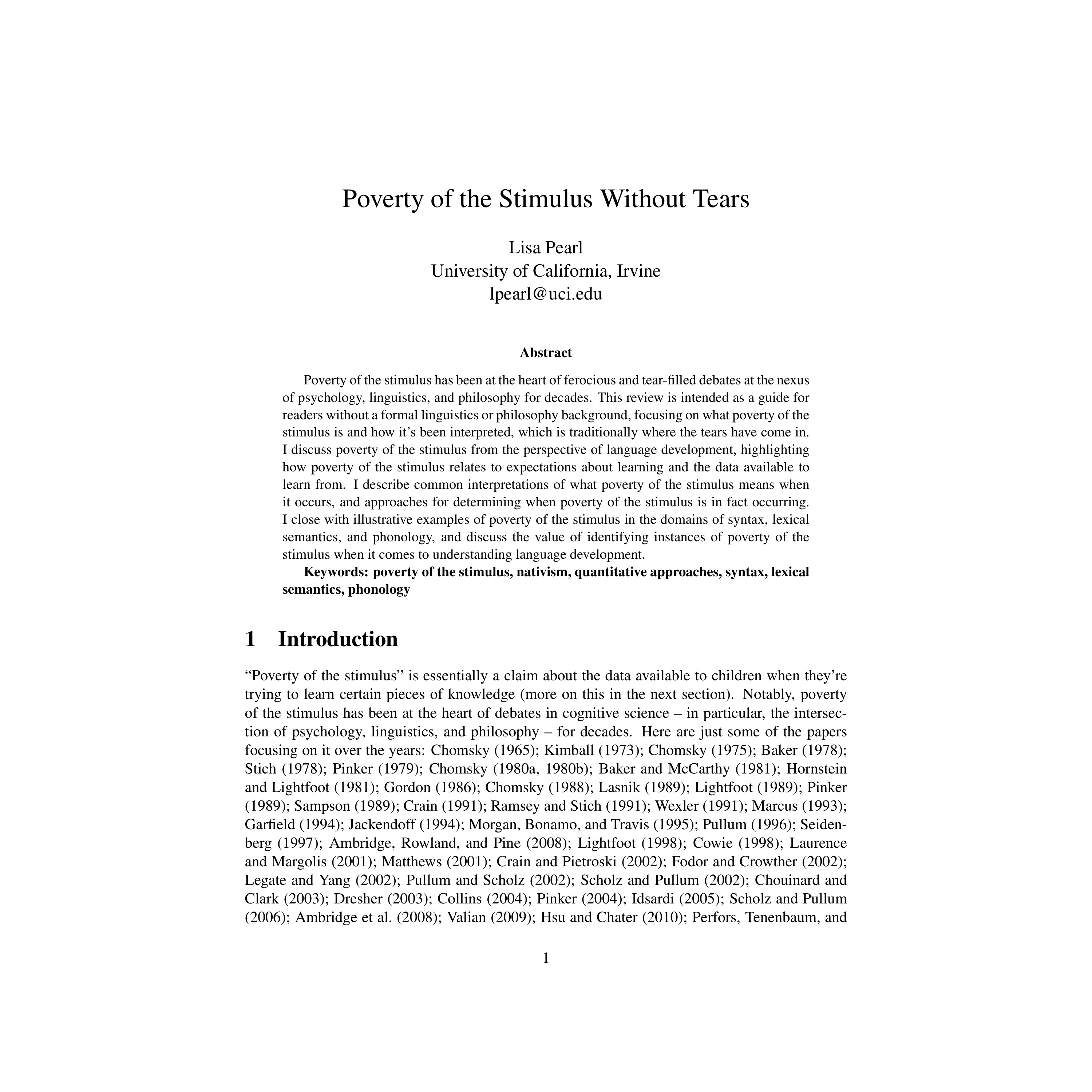
Source cover or first page for Poverty of the Stimulus Without Tears: Language Acquisition (Lisa Pearl)

Language & Linguistics

Poverty of the Stimulus Without Tears: Language Acquisition (Lisa Pearl)

Lisa Pearl reviews poverty-of-the-stimulus arguments in the study of language development.

About this episode

The central question is whether children’s available input can support the knowledge they acquire.

She distinguishes problems caused by missing, noisy, misleading, or genuinely ambiguous evidence.

Formal learning arguments and computational models help assess when the proposed problem occurs.

The review separates evidence for learning constraints from claims about language-specific innate knowledge.

Original sourceHow Children Learn the Meanings of Words (Paul Bloom)Evolutionary Psychology and Development (Palacios et al.)
Listen
Source cover or first page for Epistemic Friction: An Essay on Knowledge, Truth, and Logic (Gila Sher) — Truth 5

Philosophy & Critical Theory

Epistemic Friction: An Essay on Knowledge, Truth, and Logic (Gila Sher) — Truth 5

Gila Sher argues that knowledge requires both constraints from reality and active intellectual participation.

About this episode

She calls these complementary requirements epistemic friction and epistemic freedom.

Her foundational holism seeks to ground knowledge in both the world and the mind.

The book develops an integrated account of knowledge, truth, and logic.

It defends substantive correspondence while questioning overly simple views of how truth works.

Original sourceSimulation and Truth: Simulacra and Simulation (Jean Baudrillard) and Lyotard — Truth 4The Nature of Truth: Classic and Contemporary Perspectives (Michael P. Lynch) — Truth 2
Listen
Source cover or first page for How Children Learn the Meanings of Words (Paul Bloom)

Language & Linguistics

How Children Learn the Meanings of Words (Paul Bloom)

Paul Bloom examines how children learn what words mean.

About this episode

He argues that word learning depends on conceptual, social, and linguistic capacities working together.

Children use clues about speakers’ intentions as well as syntax and their existing knowledge.

The book considers object names, verbs, pronouns, number words, and abstract concepts.

These cases connect language acquisition to broader questions about the development of thought.

Original sourcePoverty of the Stimulus Without Tears: Language Acquisition (Lisa Pearl)Evolutionary Psychology and Development (Palacios et al.)
Listen
Source cover or first page for Simulation and Truth: Simulacra and Simulation (Jean Baudrillard) and Lyotard — Truth 4

Philosophy & Critical Theory

Simulation and Truth: Simulacra and Simulation (Jean Baudrillard) and Lyotard — Truth 4

Baudrillard examines a culture in which images and models can replace what they represent.

About this episode

His concepts of simulation and hyperreality challenge familiar distinctions between appearance and reality.

Lyotard asks how knowledge gains authority when established grand narratives lose their force.

He connects this shift to information technology, institutional power, and demands for performance.

Together, the works examine how representation and legitimation shape claims about truth.

Original sourceThe Postmodern Condition: A Report on Knowledge (Jean-François Lyotard) — Truth 3Epistemic Friction: An Essay on Knowledge, Truth, and Logic (Gila Sher) — Truth 5
Listen
Source cover or first page for The Nature of Truth: Classic and Contemporary Perspectives (Michael P. Lynch) — Truth 2

Philosophy & Critical Theory

The Nature of Truth: Classic and Contemporary Perspectives (Michael P. Lynch) — Truth 2

This collection brings together classic and contemporary philosophical accounts of truth.

About this episode

Its essays examine correspondence, coherence, pragmatist, and deflationary approaches.

The contributors debate whether truth has a substantial nature or a simpler linguistic role.

Formal theories and competing philosophical arguments clarify where these positions disagree.

The volume offers a way to compare the assumptions and limits of different theories.

Original sourceTruth: A Guide (Simon Blackburn) — Truth 1The Postmodern Condition: A Report on Knowledge (Jean-François Lyotard) — Truth 3
Listen
Source cover or first page for The Postmodern Condition: A Report on Knowledge (Jean-François Lyotard) — Truth 3

Philosophy & Critical Theory

The Postmodern Condition: A Report on Knowledge (Jean-François Lyotard) — Truth 3

Lyotard examines the changing status of knowledge in technologically advanced societies.

About this episode

He asks how science and institutions justify their authority as grand narratives lose credibility.

Information technology changes how knowledge is produced, circulated, and valued.

Efficiency and performance become influential standards for deciding which knowledge matters.

The book considers language games and new forms of inquiry beyond established rules.

Original sourceThe Nature of Truth: Classic and Contemporary Perspectives (Michael P. Lynch) — Truth 2Simulation and Truth: Simulacra and Simulation (Jean Baudrillard) and Lyotard — Truth 4
Listen
Source cover or first page for Truth: A Guide (Simon Blackburn) — Truth 1

Philosophy & Critical Theory

Truth: A Guide (Simon Blackburn) — Truth 1

Simon Blackburn surveys philosophical disputes about truth and our ability to recognize it.

About this episode

He examines relativism, objectivity, belief, and the relationship between knowledge and justification.

The discussion moves between classical arguments and modern challenges to absolute truth.

Scientific inquiry and pseudoscience illustrate the practical stakes of these disagreements.

Blackburn also considers what competing accounts of truth imply for tolerance and politics.

Original sourceThe Nature of Truth: Classic and Contemporary Perspectives (Michael P. Lynch) — Truth 2Epistemic Friction: An Essay on Knowledge, Truth, and Logic (Gila Sher) — Truth 5
Listen
Source cover or first page for The Origin of Concepts (Susan Carey)

Mind & Psychology

The Origin of Concepts (Susan Carey)

Susan Carey asks how children acquire concepts that go beyond the representations they begin with.

About this episode

The Origin of Concepts examines early systems for thinking about objects, number and agency.

Carey argues that some developmental changes require new representational systems, rather than simply more facts.

Her account of Quinian bootstrapping explains one way such conceptual change could happen.

The book connects developmental evidence with philosophical questions about what it means to learn a new concept.

Original sourceEvolutionary Psychology and Development (Palacios et al.)Human Nature (D. W. Winnicott)
Listen
Source cover or first page for Protein Folding: Introduction to Proteins (Amit Kessel & Nir Ben-Tal)

Mathematics & Science

Protein Folding: Introduction to Proteins (Amit Kessel & Nir Ben-Tal)

Kessel and Ben-Tal explain how protein structure, motion, and function fit together.

About this episode

The book connects amino-acid chemistry and molecular interactions to folding and stability.

It examines membrane proteins, binding interactions, and the physical basis of enzyme activity.

Thermodynamics and structural methods help explain how proteins work and change shape.

Applications connect these principles to disease, drugs, and biological function.

Original sourceA First Course in Causal Inference (Peng Ding)Graph Theory (Reinhard Diestel)
Listen
Source cover or first page for The Geometry of Desert: Moral Philosophy (Shelly Kagan)

Philosophy & Critical Theory

The Geometry of Desert: Moral Philosophy (Shelly Kagan)

Shelly Kagan examines what people morally deserve and how their well-being should reflect it.

About this episode

He uses graphs to compare competing accounts of virtue, reward, and deserved suffering.

The analysis distinguishes individual desert from comparisons between different people.

It asks whether giving someone too much or too little is equally bad.

These questions reveal how complex a theory of moral desert can become.

Original sourceEichmann vs. Arendt - Against the Banality of EvilSpinoza's Ethics: An Introduction (Steven Nadler)
Listen